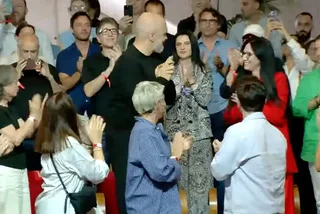
Earlier this year, the Royal Institute of British Architects (RIBA) made Prime Minister Edi Rama one of their honorary fellows.
In a profile on their website, Albania is claimed to be “rapidly emerging as a global leader in architectural imagination,” with Rama—an "instigator and provocateur”—at the helm.
The profile is riddled with fanciful inaccuracies and exaggerations. For example, it claims that Rama “has also opened the [Prime Ministry] to the public, installing works by international artists, including a neon-lit canopy in the entrance by French artist Philippe Parreno.”
This is patently false. The building, which houses the 51N4E–designed Center for Openness and Dialog, is rarely open, and if so, irregularly. Despite being praised as the “new social heart for the building,” the inner courtyard, which houses Studio Precht’s “Garden of Eden,” is not public at all, nor is the exhibition of many of the socialist realist sculptures on the higher floors that in fact belong to the public collection of the Gallery of Fine Arts.
Philippe Parreno’s Marquee Tirana has been seriously neglected over the last few years and has disappeared behind an improvised “shield,” while Carsten Höller’s Triple Mushroom has fully disappeared from public space.
Surprisingly, RIBA also claims that “during his tenure [Rama] won the support and appreciation of the Albanian public for his creative and efficient ways of promoting art and culture in Albania.”
The thousands of protesters marching every night now for more than a month think differently.
He has destroyed the National Theater and indefinitely closed the National Gallery of Arts and National History Museum; the Theater for Opera and Ballet was renovated through a corrupt tender.
Artists are still not a protected category with barely any state support; the Ministry of Culture’s budget is a joke.
Evidently, the only artist the Albanian government has been promoting is Rama himself.
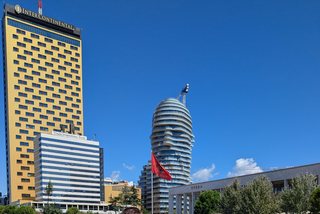
In the profile, Rama is given ample opportunity to promote his architectural vision of Albania, seemingly without any pushback or critical context. Even unsubstantiated claims about “a new underground museum/parking garage” underneath Mother Theresa Square get a full pass.
In all this, RIBA shows itself to be a full extension of Rama’s refashioning of architecture as political propaganda, and they fully go with it.
Also, RIBA’s award committee concurs: "Edi Rama is the man who changed a whole city. Now there is a new Tirana, colourful, happy, with a new and improved infrastructure and cultural life.”
I reached out to RIBA to ask whether, considering Rama’s aggressive response to the more than a month of massive popular protests against his government in the country; the many ministers and other party members that have been indicted for corruption; and the multiple projects approved by him personally as head of the National Territorial Council under investigation for corruption and the laundering of drug money, they would reconsider his honorary fellowship.
They responded as follows:
RIBA is a UK charitable body and professional institute. While we promote excellence in architecture and the built environment, we do not act as a political organisation and do not generally take positions on contested political, planning or development matters, whether in the UK or internationally. Questions relating to the legality, environmental assessment, planning approval and wider public policy implications of specific developments are matters for the relevant authorities and processes in the jurisdictions concerned.
The fact of the matter is that RIBA, by their appointment of Rama as an honorary fellow, has taken up a clear political position and has acted as an extension of Rama’s propaganda machine.
The fact that it is a “charitable body and professional institute” does not insulate it from the consequences of its decisions nor absolve it from its responsibilities.
RIBA’s 2019 nomination of Boris Johnson as an honorary fellow already showed its poor judgment—their support for Edi Rama will prove even more disastrous.
Shpërndaje te miqtë