Unsurprisingly, over the weekend there has been little response to my article from last week from the international architects in The Albanian Files, despite my kind invitation.
The only one who took the time to write was Martin Sobota of Cityförster, who, in his contribution to the above publication, writes: “We were fascinated by questions around how the last undeveloped coast of the Mediterranean could develop a new model instead of falling prey to rapacious mass tourism that ultimately destroys what it seeks.”
But instead of Sobota speaking up publicly against the destruction of the “rapacious mass tourism” that is currently destroying the Albanian coast, he wrote me an email in Dutch:
Oh my god, Vincent. Maybe you know Reinier’s essays. This piece is of course meant ironically. I do get it that in the face of the most recent events you lose your sense of humor, but I also know for sure that Reinier doesn’t want to cancel elections or elevate Rama to King. And we of course don’t either.
To answer your further questions:
We have never paid any money or given any benefits to government officials, we do all our work based on invoices and official bank transfer and as far as possible we do background checks on our clients.
The last boilerplate paragraph was in English, no doubt sent to him by his legal department and copy-pasted into his email. One wonders what it means for him to do “background checks” on his client Gjikuria shpk, which appears to have malappropriated EU agricultural subsidies.
Anyhow, the argument “but it is ironical/satirical” has become the preferred counterattack of the starchitect community (also called the “art army” or “arch army,” after their WhatsApp group), and even Prime Minister Rama, in his recent podcast, resorted to this defense, broadcasted over the weekend:
This book is called The Albanian Files. It is one of the most important books that has been published in recent years in the light of the field of architecture and urban planning in Europe and the world. […]
The Albanian Files has been targeted by the revolutionary inquisition – I cannot call it intellectual, because it isn’t – while it is not my book, and it is not a publication controlled by me. I just wrote the preface. […]
Of course there are things that can be discussed, but to dissect a publication like this, as if it were the Chinese Cultural Revolution, and then to grab on to a text that is auto-ironical of an architect that represents one of the greatest studios in the history of contemporary architecture, OMA, founded and directed by the legendary Rem Koolhaas, that takes the cake! […]
This letter has been turned upside down. However, it shows that in fact the book is completely free, without control. All contributors had complete freedom in their contributions. […] The letter of Reinier de Graaf is evidence of this autonomy. […] You have to know the author, he has a globally recognized ironical, satirical, hyperbolical style that he uses in his work.
Both Sobota and Rama doubt that I “know the author.” Therefore, perhaps, we can have a look at the other things De Graaf has said, for example during the Bread and Heart Conference in 2025.
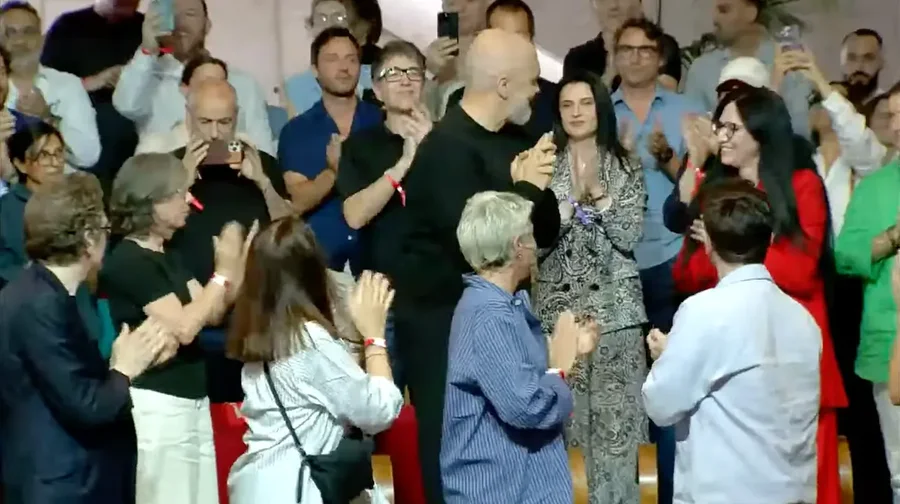
De Graaf appears in the first panel on the theme of failures, together with Freek Persyn of 51NE4, right after Rama’s opening speech welcoming his “mighty art army,” talking of the conference in lofty terms such as a “bajram of the spirit,” a “sacrifice of egos,” a “geometry of belonging,” and a “bold bet on architecture.”
Persyn, whose reconstruction of Skënderbeg Square is currently under investigation by the Special Anti-Corruption Prosecution, was unable to speak much in the first minutes, moved to tears by Rama’s rhapsody:
“As you probably can all witness I am very moved by what has been just said, and I cannot hide it.”
When asked by the moderator what is so moving, Persyn, who has designed Rama’s private residence, office, and the very building in which the festival is held:
“What is moving to me is that I feel that these words [of Rama] are true.” He tears up. Thunderous applause. “The fact that he [Rama] is able to articulate the same thing that I feel is quite… rare.”
My only reference to this type of public emotional display in response to an Albanian politician’s speech are the communist reels of the popular adulation shown to former dictator Enver Hoxha.
Persyn doesn’t come across as an “autonomous” or “independent” architect but as someone who has staked his entire career, perhaps even a large part of his identity and emotional well-being, on Albania and his relation to its great leader. Since the panel was supposed to be on failures, Persyn’s subconscious perhaps gave way… but I digress.
Freek, if you read this, therapy is an option.
De Graaf feels he cannot stay behind now that the emotional stakes are so high and the boss is sitting in front of him, leering at the panel:
“I am also deeply moved, even if I may not carry the external hallmarks of being moved in the same way as Freek has just displayed. I am moved, but more than that I am curiously bewildered by Albania.”
He then continues to list a bunch of clichés he is “bewildered” by that don’t merit repeating.
My question is: is that also ironic?
In the video he seems quite sincere.
Let us, in fact, listen to De Graaf’s writing, in which this internationally renowned satirist and ironist—who, according to our prime minister—revels in hyperbole. I cite here from his recent “manifesto” Architecture against Architecture:
The larger societal issues that impact architecture – the same issues that impact any other profession – were none of our business. That is, until the world made them our business. In no uncertain terms. Time has finally caught up with architecture, only to expose it as being out of touch.
This doesn’t sound ironic to me.
But it is surprising that De Graaf, now that the Albanians are en masse addressing the social impact of his profession, chose to remain silent. Maybe he is as out of touch as his colleagues, despite his provocative words?
Indeed, as De Graaf remarks, “Architecture in its current form has lost all credibility.”
Why then be “deeply moved” by Rama’s speech, which claimed the exact opposite? Shouldn’t De Graaf – if he were true to his own words – have stood up during the Bread and Heart Festival and loudly proclaimed the Albanian prime minister was full of shit?
No, of course not, because De Graaf wants to build some more in Albania and make money for himself and his firm, no matter where that money may come from.
As De Graaf himself admits, “irony allows an endless deflection,” and it is this deflection that Sobota, Rama, and whoever else is hastily workshopping rhetorical defenses in the Arch Army WhatsApp group to halt this PR disaster, have tried to use as a defense.
But they are sadly mistaken: none of this is irony, all of it hypocrisy.
Shpërndaje te miqtë