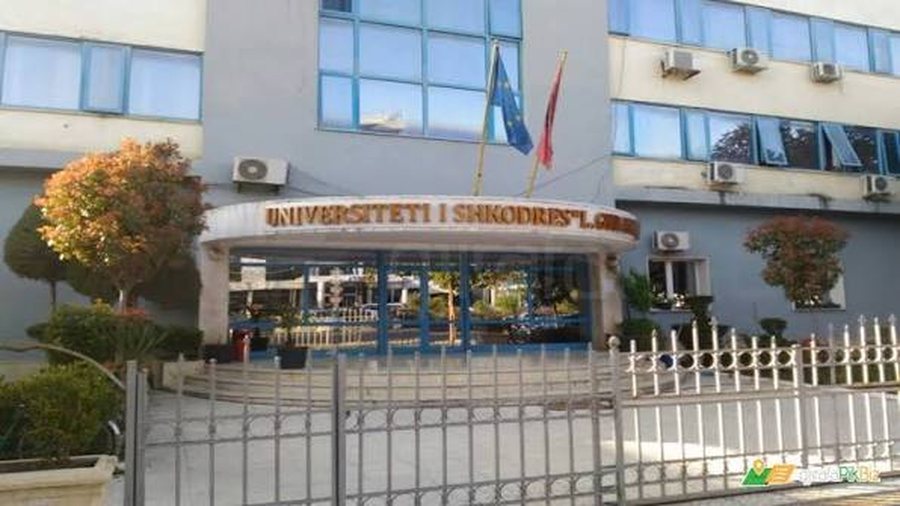
Few days ago, Prof. Dr. Tonin Gjuraj resigned as rector of the University of Shkodra “Luigj Gurakuqi,” submitting an irrevocable letter of resignation to the minister of Education and Sports. Elected two years earlier by the university community, he left after a prolonged conflict with the university’s Board of Administration over effective control of the institution, centered on the appointment of the administrator, the official responsible for financial and administrative management.
In his letter, Prof. Gjuraj framed his departure as a refusal to continue under conditions that, in his view, undermined university autonomy and the reform mandate he had received from the academic community upon election as rector.
Autonomy is important because it protects the university community’s ability to set academic priorities, defend standards, and speak in public without being overruled by political or administrative power. Prof. Gjuraj’s letter describes the opposite: a reform mandate received from the university community constrained by the Board of Administration and by political-administrative influence over the key levers of institutional decision-making.
This resignation matters, because it links university autonomy with Albania’s broader debate on civic space and the questions of legality and the protection of public goods that underpin it. Civic space is usually discussed in terms of protest squares, independent media, civil society organizations, and public consultation processes, but it is also sustained by universities, where students and researchers learn to test ideas, produce evidence, debate choices that affect society, and question authority.
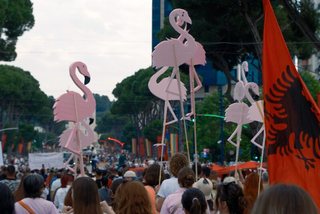
This link between university autonomy and civic space becomes clearer in the civic climate created by the Flamingo Revolution. The mobilization around the Vjosa-Narta protected landscape has become one of Albania’s most visible civic protests in recent years, because it speaks to a wider concern about how public goods are governed.
Citizens are demanding decision-making that is transparent, accountable, open to participation and consultation, and grounded in public trust and protection of public interest rather than arbitrary power or vested interests.
Universities belong to the same category of public goods. The weakening of their autonomy or the blocking of their reform may be less visible than a wire fence around a protected landscape, yet its implications are profound: students, researchers, cities, and society all risk losing a space where knowledge, criticism, and democratic responsibility can take shape.
Prof. Gjuraj’s resignation brings this silent damage into view.
Prof. Gjuraj’s resignation letter describes a reform mandate constrained through ordinary institutional mechanisms, without any formal abolition of autonomy. He links his mandate to the university community, institutional transformation, and the need to keep the university away from political influence while arguing that the practical power to act rests with the Board of Administration.
Under Albania's 2015 Law on Higher Education, that separation is built in, and it can leave autonomy intact on paper and weak in practice, especially where appointments, budgets, and institutional silence function as channels of influence. Academic freedom depends on the same conditions: without real institutional autonomy, the freedom to teach, research, and speak has little practical protection.
This is not new. The student protests of 2018 and 2019 challenged the same governance model created by the 2015 law and the same democratic deficit visible today in Shkodra: the university community gives the institution its legitimacy, yet key decisions over its direction can remain distant from students, academic staff, and elected academic leadership.
A new higher-education law that focuses only on internationalization, labor markets, or competitiveness would miss the deeper question exposed by Prof. Gjuraj’s resignation: whether Albania's universities can act as autonomous civic institutions while academic mandates remain exposed to political-administrative power.
Our work with universities, researchers, young people, and local communities points to the same conclusion: university transformation depends on the conditions under which institutions operate.
Autonomy, transparent governance, academic integrity, meaningful student participation, research capacity, and openness to society determine whether universities can build credible partnerships, cooperate with cities and communities, engage the diaspora, use digital transformation responsibly, and produce knowledge in the public interest.
Without these conditions, the language of innovation, mobility, and university-to-society cooperation remains fragile because the institutions expected to deliver change do not have the practical freedom and trust needed to do so.
These structural conditions also determine whether Albania’s expected progress on Chapters 25 and 26 is substantive or mainly formal. The government presents the country as ready, or close to ready, to move toward closing the chapters on science and research, education, and culture in 2026.
On paper, that may reflect laws, strategies, institutional structures, and participation in European programs. In practice, the credibility of these chapters depends on the universities that must carry them.
Prof. Gjuraj’s resignation should therefore prompt a more careful reading of accession readiness in these fields, one that looks more to the autonomy, integrity, and governing conditions of the institutions expected to deliver them.
The Flamingo Revolution also turns the challenge back on universities themselves.
A mobilization of this kind asks universities whether they will watch from the sidelines or take part by putting evidence, expertise, and public debate at the service of society. That role requires more than autonomy; it requires academic freedom and the readiness to use it, even when silence is safer.
Autonomy then carries its own obligations: rectors, boards, and academic bodies owe transparency, accountability, and openness to their own communities and must guard against patronage, complacency, and capture from within.
It also shapes what students are for: the habit of questioning power, testing official claims, and defending public goods, not just acquiring professional skills.
The debate on the new higher-education law should hold universities to the same standard the Flamingo Revolution made visible: public goods require governance that is transparent, accountable, participatory, and worthy of trust. Prof. Gjuraj's resignation should push that debate beyond programs, markets, and internationalization, toward the distribution of real power inside Albania's public universities.
Shpërndaje te miqtë