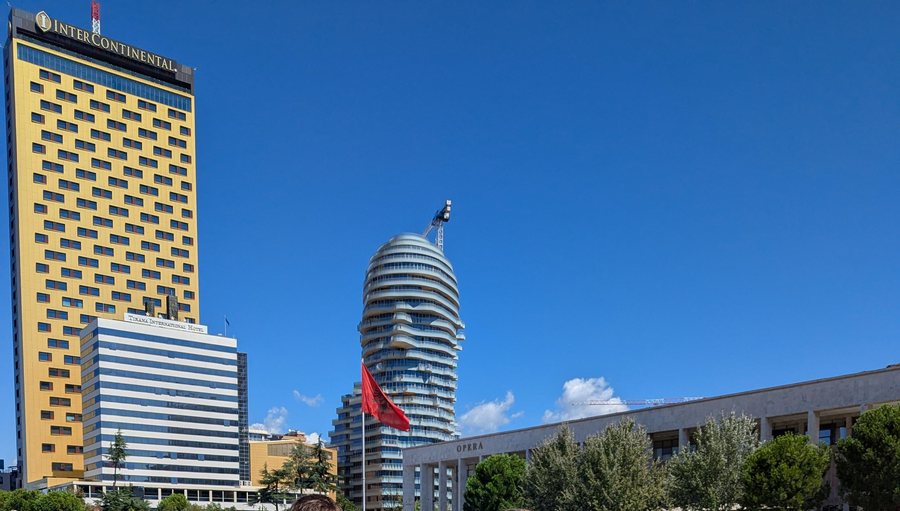
In 1860 the Belgian government organized an international architecture competition for a new courthouse in Brussels. The winning architect, Joseph Poelaert, had also been part of the jury. A process of expropriations started that destroyed an entire popular neighborhood in the city center for a megalomaniac construction project that was larger than St Peter's Basilica in Rome. There were massive protests, but the courthouse was built nonetheless. In 1984 the building was surrounded by rented scaffolding for a renovation process that never really started. Meanwhile, the enormous building sits mostly empty.
All of this sounds terribly familiar to anyone living in Tirana of the twenty-first century. All of this except for the fact that until today one of the gravest insults in the neighborhood surrounding the Justice Palace in Brussels is "schieven arkitekt" – "crooked architect"! I would not be surprised if somewhere in the future "arkitekt i shtrembër" becomes a proper Albanian insult.
While after the removal of prime minister Edi Rama from power (again: not if, but when) it will certainly be no little effort to bring all of those who sucked Albania dry of its resources, land, and youth to justice, those international architects who for more than two decades have provided a cover of prestige for what has now clearly turned out to be plain corruption and criminal money laundering should be held to account.
"Archistars" such as Winy Maas, Bjarke Ingels, and Stefano Boeri will need to be summoned by a parliamentary inquiry – if not by SPAK – to explain precisely how it was possible that one of the poorest countries in Europe was able to build the most "visionary" skyscrapers. Where did they think the money was coming from? Did they ever do their due diligence on their projects or did they simply take the cash and enjoy the praise of the great leader?
Fortunately, international architects are so self-centered and delusional that they openly flaunt the evidence of their corruption and sycophancy. For example, the Royal British Architects (RIBA), whose members apparently "behave with integrity and strive to safeguard and improve the standing, reputation and dignity of the Institute" and whose Code of Conduct lists "Conflicts of interest; Bribery and corruption; Criminal conviction/disqualification as a director/sanction" as potential issues, chose to award Rama with a honorary fellowship earlier in 2026, while the Balluku corruption scandal was exploding all over the news.
In a profile accompanying the prestigious fellowship, RIBA shows without any shame several projects that have recently come under scrutiny of SPAK, including Samir Mane's Green Coast project, which reportedly attracted criminal investment in the millions of euros, and the "Garden of Eden" designed by Studio Precht, "a new social heart" for the Prime Ministry that no one is ever allowed to see – despite being built with public money.
More recently – and even more shamelessly – every single international architect provided evidence of their crimes in a publication called unironically The Albanian Files published by Lars Müller Publishers. Notably, not a single Albanian architect appears in the book.
In his introduction, Edi Rama writes:
In Albania, the word file carries a long and painful memory. Files were instruments of fear. […] Files were not meant for understanding. The were meant for control.
Apart from the fact that Rama's Socialist government has in fact never fully opened the communist "files" and severely hampers historical research and restitution for the crimes of the dictatorship in which has own father was complicit, it is obvious that the files gathered in this architecture publication have the exact same purpose. They are meant to control the narrative. Fortunately, they fool absolutely no one.
Architecture in Albania – as it was in nineteenth-century Brussels – has become a tool to oppress and submit the Albanian population: to destroy their neighborhoods, villages, beaches, and mountains. Architecture has become a tool to control the image of Albania and its great leader, and the flashiness of each new skyscraper is there to thwart any understanding of where the money is coming from, which criminal is involved, and the very real question of who is ever going to be able to afford to live there.
At the end of the introduction after musing about the "democratic wager of new places to live," the "geometry of belonging," and a "communion of intentions," Rama writes:
Opening the files may tell you far more. And who knows, perhaps it will even be a different story from the one I have just written.
Indeed, rather than portraying some type of architectural renaissance, The Albanian Files provides a list of who-is-who in Albanian nepotism, money-laundering, and corruption. Erisa Kryeziu dhe Vjolanda Peca of Citizens.al already mapped out how the publication for the first time shows the extent of the damage done to the Albanian natural environment, since public consultations are systematically avoided and hardly any public information exists about the many "strategic investments." I will attend to how architects appear to see themselves in all this.
The book starts with the studio that started it all, the Belgians of 51N4E, which also provided the cover art (and whose Skënderbeg Square project is systematically called, by the majority of contributors, "inspiring"). What their contribution makes clear from the get go is that this book is a piece of dissimulation and fiction, a tool of propaganda that aims to provides justifications after the fact.
For example, their list of projects obscures the fact that they designed the grave of Dritan Hoxha ("For D.H.," 2008), the late owner of Top Channel who stands at the origins of Rama's political career. Their list also doesn't include the fact that they designed Rama's private residence (unless they hid it as "Mountain Collection," 2004), and fails to mention that their most political works, including the Center for Openness and Dialogue (2014) and the Bronze Monument for those killed during the 2011 anti-government protests (2012), were never acknowledged when they were actually built. Back then, the Albanian government simply refused to inform its citizens who had "won" the tender. 51N4E's work was implemented without any form of public accountability, and until this day it is unclear how much this firm, which also provided Rama's daughter Rea Xhillari with an internship, has actually profited.
Other aspects of controversial architectural projects in Tirana are also clarified. For example, when Studio Precht's "Garden of Eden" was built inside the Prime Minstry, paid for by the Albanian Development Fund, the government refused to disclose who was the construction company. Thanks to The Albanian Files, we now know that was Fusha shpk, currently implicated in several SPAK dossiers including the tenders for the "inspiring" Skënderbeg Square reconstruction.
The same company also appears elsewehere. During the protests against the destruction of the National Theater in 2018, architect Bjarke Ingels refused to reveal the name of the private developer who had commissioned him, while the Rama government was busy crafting custom legislation to give away the public land for private development. And now, in The Albanian Files, we find that his contact with Fusha shpk goes back to 2015, way before we first started reporting on the project:
During our visit [in 2015], we met the people from Fusha shpk – the local contractor working on Skanderbeg Square. We agreed to pursue one of the upcoming public projects together. In the fall of 2017, we signed a contract with Fusha to design a theater as part of a city block featuring various urban functions.
My question is: Why was this information already revealed in 2020 to the Danish public, but never shared with the citizens of Tirana who were gaslit for years about the destiny of the National Theater? I would love to hear from Ingels the precise timeline of this entire "public project" that was never made public, preferably in front of a parliamentary commission if he ever dares to set foot again on Albanian soil.
Nearly every contribution contains some type of anecdote about how this or that studio received an "unexpected," "spontaneous," or "surprising" invitation to come to Albania, only then to discover, just like Ivanka Trump, a "terra incognita" full of compliant natives, "untouched nature," and "stunning sites." The general attitude is perhaps best illustrated with the following comic strip from Luca Dini's contribution, showing a giant yacht crashing into a highrise buildings with the following caption:
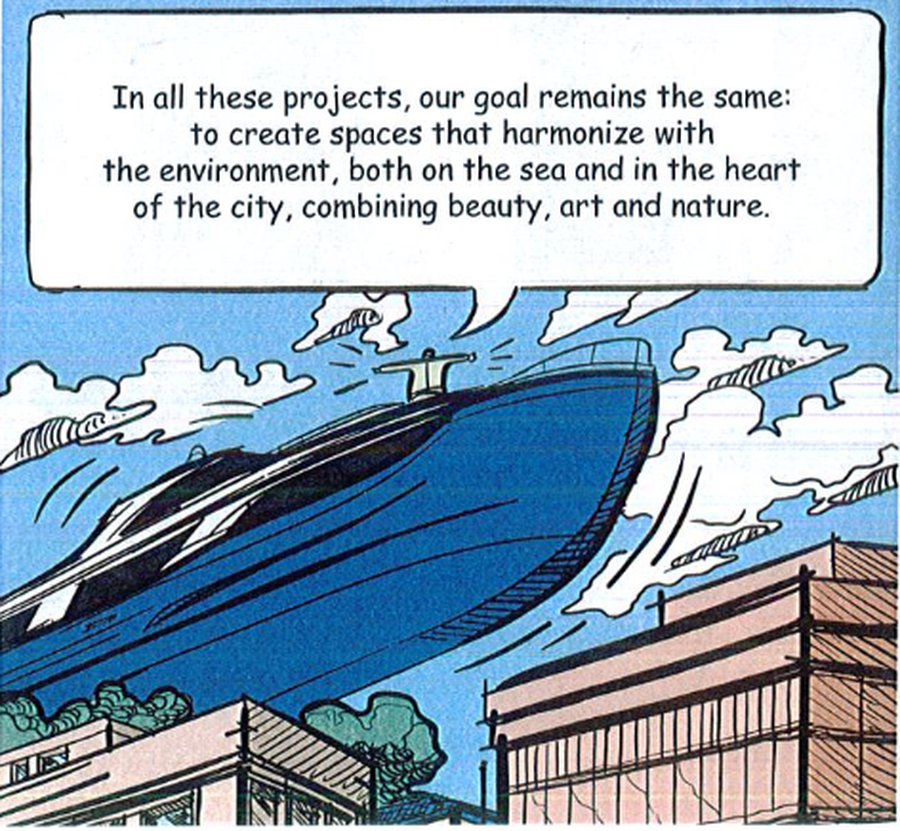
In all these projects, our goal remains the same: to create spaces that harmonize with the environment, both on the sea and in the heart of the city, combining beauty, art and nature.
We take them to their word! Here are some other examples of "surprised" architects:
Prime Minister Edi Rama sent me a message on Instagram, asking if I would be interested in working in Albania. (Christ Precht, who designed the Rama's Garden of Eden)
And:
On Wednesday, May 1, 2024, a holiday, at 10:00 p.m., my friend Pablo Bofill called me to say that "Edi" was going to call me. […] In short order we were asked to do two projects in Tirana. (Sam Chermayeff)
Another one:
Benedetta Tagliabue texted me asking if I was OK with having my contact number shared with Albania's prime minister. I said, of course. Five minutes later I was contacted by the PM, asking if I could come to Tirana to discuss the possibility of a project. (Alejandro Aravena)
How is this a proper way to deal with public procurement, or in this case, a private project for a massive skyscraper? What is the role of the Albanian prime minister in securing international architects for private developers? What policy is followed here? Clearly, sooner or later, SPAK will need to call upon the prime minister to testify in every single real estate development project, since the The Albanian Files provide clear evidence he is personally involved in nearly every highrise or tourism development project. All lines come trace back to him.
The architects, on their part, also openly and shamelessly acknowledge this:
- "The project for Albania with the vision and support of Prime Minister Edi Rama is unique." (Álvaro Siza, who destroys the beautiful beach of Rana e hedhun)
- "The prime minister Edi Rama has put architecture on his priority list; he attends to it in the only viable way – by being personally involved." (Christian Kerez, who clearly has never heard of rule of law but designs a seaside resort in Shëngjin)
- "Albania has a great leader interested in culture, art, and architecture, which leads to visionary, forward-looking projects. This is nowadays sadly very rare. It is a great honor to work with the prime minister's team […] a visionary leader." (Archi-tectonics, several towers in Tirana)
- "Even with the flexibility in regulations, there's a clear vision, coming from the prime minister, for Albania's architectural and urban development" (Arquitectura-G, several towers in Tirana)
- "The project in Albanian that is an example is Prime Minister Edi Rama's project for Albania itself […]. For me, this from Prime Minister Edi Rama […] provides enough motivation to continue." (Camilo Rebelo, who destroys part of the Lake Park in Tirana and develops a "private" masterplan for seaside pearl Borsh)
- "Albania's leadership, particularly the prime minister, demonstrates and exceptional interest in an understanding of art and architecture. […] With every completed project, Albania's cities and its overall landscape become more livable and appealing." (Cebra, responsible for the absolute monstrosity called "Mount Tirana" and "resorts" near Durrës and Himara)
- "The most representative work is the Albanian Project – a collection of initiatives stemming from Edi Rama's macro artistic vision at the start of the millennium." (Davide Macullo, responsible for the destruction of Farkë lakeside)
- "What sets Albania apart is its openness to new ideas and its willingness to take risks. Prime Minister Edi Rama's belief in architecture as a vital part of the country's future sets the tone, and there's a refreshing directness in how projects are approached." (Winy Maas, on whose embarrassing inanity I will not comment any further)
Even though Albanian voices are nearly completely absent from the publication, they do often appear as "local partners." One of the main ones is SON Architects, known for its historically close relations with the Municipality of Tirana. Their involvement in multiple of the projects listed in The Albanian Files would be practical entrypoint for SPAK.
We also find old pals of Rama such as Anri Sala (connected to the corrupt Skënderbeg Square redesign of 51N4E and Fusha – looking foward to his testimony) and Adrian Paci (involved with Keuhn Malvezza in the Expo Albania building, and a tower of Taller Hector Barrosso), even though the latter has recently, in the face of the massive protests, tried to publicly distance himself from the government he is serving, with this sort of 1980s word salad: "It is clear that today a new pact is sought between society and the political elite and this need invites the governing class to take a step backward." Others will try to do the same as resistance to the Rama government grows. Let us not forget which side they defended tooth and nail and how they profited from it.
Some architects go even further, and openly express their disrespect for democracy and public consultation, which of course is fully in line with the autocratic mode of government of Rama who sees politics as "painting a canvas." This is perhaps most succinctly articulated by architect Manuel Aires Mateus, involved in seaside destruction in Shëngjin, Saranda, Ksamil, and Vlora: "There are times when things have to be top-down, so this quality has to be forced in order to create that need that doesn't exist at the moment."
But perhaps the one architect has best articulated the utter shamelessness with which each single one of them vies for the graces of the prime minister is Reinier de Graaf of renowned Dutch architecture firm OMA. Surprisingly, De Graaf recently published a "manifesto," Architecture against Architecture, in which he asks: "What can prevent iconic structures from being embroiled in money laundering? And the vital question: What projects should architects refuse on moral grounds?"
De Graaf has been kind enough to provide us with some sense of a possible answer, through a letter he wrote to Rama, and which he thought prudent to make public in The Albanian Files:
I don't say this lightly, but for us architects, it would be best if the upcoming elections [in 2025] were simply called off. I would even go a step further. Given Albania's enduring status as an enlightened architectural patron, our profession would benefit greatly if the country if the country never had another election again, and if you, after your fifth consecutive term as prime minister, would just continue as president for life – maybe even King. […] I know that what I am asking of you is no small sacrifice, yet it is one of momentous importance. I hope you will consider.
I don't say this lightly, but every single architect whose damning voice has been recorded in The Albanian Files is a direct threat to Albanian democracy, coated in the flimsiest of theoretical outfits. This publication presents 750 pages of evidence of their moral bankruptcy, disdain for well-managed public processes, hatred of the environment, and ignorance of the rule of law. For the sake of architecture itself, whatever future, post-Rama government will be installed – and I have no doubt it will come – must hold each and everyone of these people to account: what they knew, whom they talked to, whose money they accepted. They will have to pay.
I reached out to every single architecture firm in the book, to respond to Reinier de Graaf's call for canceling the elections and declaration of the monarchy in Albania. Not a single one responded.