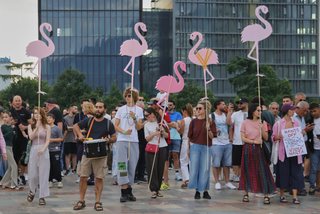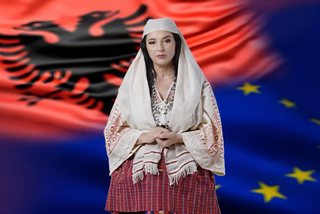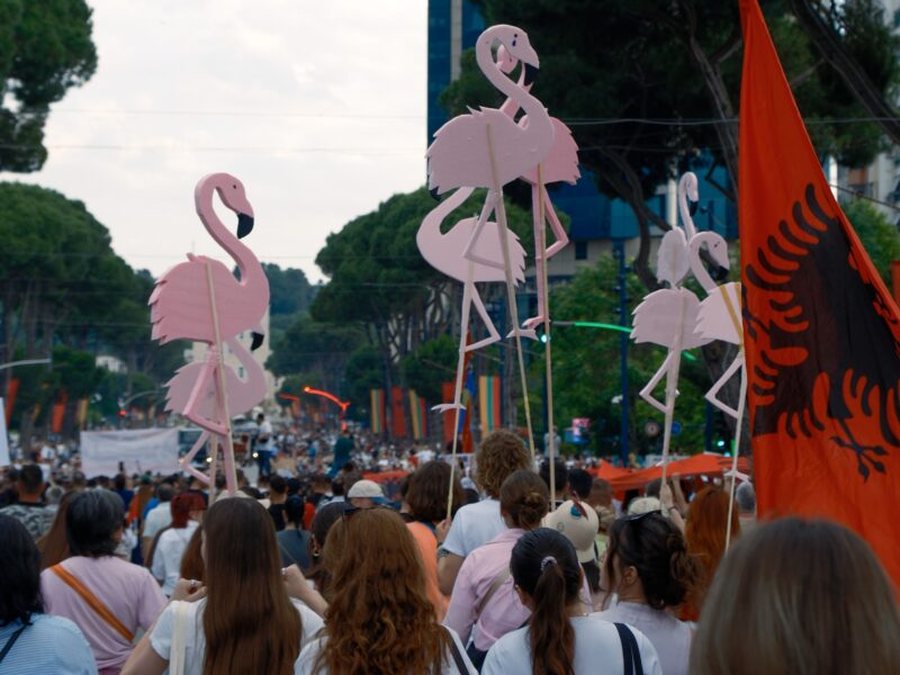
As the "Flamingo Revolution" anti-ruling class protests in Albania enter their third week unabated, we are witnessing an increasing degradation of Prime Minister Edi Rama's hold over the narrative.
His public appearances have become erratic, his interviews with international journalists cringy. His spin doctor, Endri Fuga, is gone. His consigliere, Engjëll Agaçi, is in hiding from SPAK. The social media bot army that Erion Veliaj used to maintain at the Tirana municipality, in tatters. These crucial absences are now dearly felt.
Rama's usual combination of charm, bluster, and intimidation no longer works its magic, and it is clear from the lackluster response to his own "counter-rallies" that even within the Socialist Party there is growing feeling that the end of an era is near. The rats are leaving the sinking ship.
But to understand what this end may actually entail, it is worth attending to the question how we got here in the first place.
A fundemental question faced by a small country with little natural resources is how to develop its economy. Any politician looking at the Albanian situation would naturally respond by saying: tourism. Edi Rama was certainly not the first who came up with this answer, but he is, however, the architect of the system that shaped its implementation in the last decade or so.
The mechanism that Rama developed – the very mechanism the Flamingo Revolution intends to demolish – is built on the following reasoning: In order to develop tourism you need foreign direct investment. But in order to attract legitimate foreign direct investment you need well-developed public infrastructure, which Albania lacks. So I will need investors who have no such requirements.
Rama found these investors in criminal groups. Drugs money, first from marijuana and later from cocaine, is laundered through real-estate projects that develop the country. The same criminal money pays for elections. Public administration becomes fully subservient to criminal interests and often its actual extension, as the case of Belinda Balluku has clearly shown. And Rama rules over it all as its architect-in-chief.
Rama's wager was that he would have just enough time, before SPAK got on its feet and the demands of the EU accession process would constrain his possibilities, to "upgrade" to international investors à la the Saudis or Kushner, whose capital is somehow beyond corruption, to keep his development model for Albania (from which he and the rest of the ruling class profit illegally and immensely) on the rails.
But reality is always more resistant.
By trying to upgrade to Kushner-level global criminal capital, Rama has exposed himself to a type of scrutiny he has not previously experienced, in particular from the international press and social media influencers. With regards to the former, he has only ever had to deal with softball questions from so-called architecture critics, balanced with the occasional paid-for puff piece heralding his global vision. The latter he was able to impress with his parrot, basketball hoop, and swagger.
No more. A completely different type of journalist, hardened in the US Trumpian culture wars, has now jumped onto his case, and bloggers and social media influencers have followed suit, attracted by the irresistable combination of tropical birds and political turmoil. Rama is clearly out of his depth and walks on the stage like a bad meme.
But the second consequence of trying to transcend the endless Albanian infighting between different mafia groups, oligarchs, and media-construction conglomerates – a fight that even has spilled over openly into his own Socialist Party – is that it gave the Albanian people a common enemy, a signifier they could all gather around allowing them to at least temporarily suspend their own histories of strife and animosity.
It is my greatest hope that this provides an opening to formulate an alternative political platform, built on a completely different answer to the perennial question: how do we develop Albania?
Shpërndaje te miqtë