What has happened in Hungary?
After our failed revolutions, the 15th of March in 1848, the 23rd of October in 1956, the day, April 12th, 2026, will enter Hungarian history as an electoral revolution. It happened despite the state capture, the Media hegemony of the government party, and Hungary not being considered a democracy since 2019 by Freedom House.
Many Hungarians didn’t even believe it beforehand that the Orbán-regime could be defeated at a parliamentary election. Luckily, they proved to be wrong.
Viktor Orbán installing in power in 2010 had one wish, a promise to himself that he made after his defeat in 2002, that if he got elected again, he would stay in power for good. He wanted to build a system in which he could never be defeated again.
Immediately after his major victory in 2010 earning him a constitutional majority in Parliament, he started to build up the Hungarian “Death star”, a new political system shaped for cementing his power and securing his future victories. He turned the Parliament into a “law factory” starting with a brand-new constitution written by Fidesz politicians that was adopted without any consultation with other parties, civil organizations or citizens.
The same happened with the new Media law and the Electoral law, as well. There were mass protests and demonstrations against these laws, but the political leadership didn’t seem to bother. They instead chose the back entrance of the Opera house to escape the angry crowds, where the official ceremony of the new Constitution took place.
This strategy had worked to perfection. In combination with the regular fake news and hate spreading billboard campaigns, it secured the constitutional majority throughout three more (!) general elections; in 2014, in 2018, and in 2022. So, what happened in these past years? How could this electoral revolution happen in an informational autocracy type of regime?
In the 2010s, there was economic prosperity on one hand getting out of the financial crisis, and on the other hand the EU funds coming to Hungary had already reached their peak amount, so Orbán could take the political advantage of the positive circumstances.
The EU was also bit too patient with Hungary, and it took too long to react to the democratic backsliding in Hungary and finally introduce the rule of law mechanism. The freezing of the funds, the end of the ERASMUS and HORIZON programs for most Hungarian universities – the ones turned into public trust foundations under political control – were belated, but strong strikes for the Orbán regime.
State corruption, a type of crony capitalism with a system of oligarchs, doesn’t favor a merit-based market economy. On the long run, it is not even sustainable. That’s why Hungary has slipped to the bottom of the ratings in almost every field within the EU. The population also started to feel the consequences; high inflation, low wages, failing public services in health care and education, etc.
The vital political hit for the regime came unexpectedly, in February 2024 with the “pardon scandal”.
A lawyer accidentally discovered that a pedophile aide was pardoned by the president the previous year on the occasion of the Pope’s visit to Hungary. It caused such an outrage, that within a week, Katalin Novák, the president of the Republic had to resign, as well as Judit Varga, the former justice minister who countersigned this decision.
This was the turning point, where Fidesz lost a control of the narrative; Orbán whose leading slogan was “Family friendly Hungary” and child protection – despite saving himself with these two resignations – got the strongest ever political blow, and his system started cracking. This moment brought the appearance of Péter Magyar, the former husband of Judit Varga. He walked into the studio of an independent News outlet and gave his first interview viewed by millions within a couple of days.
A charismatic guy from Fidesz inner circles criticizing the party was unheard of before. People were eager to find a politician whom they could finally believe in after the failures and incompetence of the former opposition figures. Péter Magyar soon found an existing small party, the TISZA party, “Tisztelet és Szabadság” (Respect and Freedom) and the rest is history.
During the last days before the elections there was already a revolutionary feeling in the streets of Budapest, a very heated atmosphere on one hand due to the government billboard campaign, on the other hand people angry about them, “correcting” the billboards expressing opposition to the government propaganda.
Documentaries came out from whistleblowers on the social Media sites; the story of police captain Bence Szabo, of the military officer Szilveszter Pálinkás, the documentary The Price of the Vote, all showed how rotten the Orbán-regime was.
Parallel to this, Péter Magyar did his final rally over the country visiting 6-7 places daily in the last weeks, where cheering crowds gathered every time even in former Fidesz strongholds to listen to him, letting themselves carried away by the system-changing emotion and the ray of hope that finally Hungarians can get rid of this suppressing illiberal regime.
Most of us could hardly believe that it really happened.
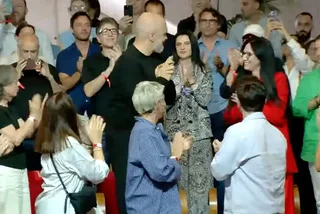
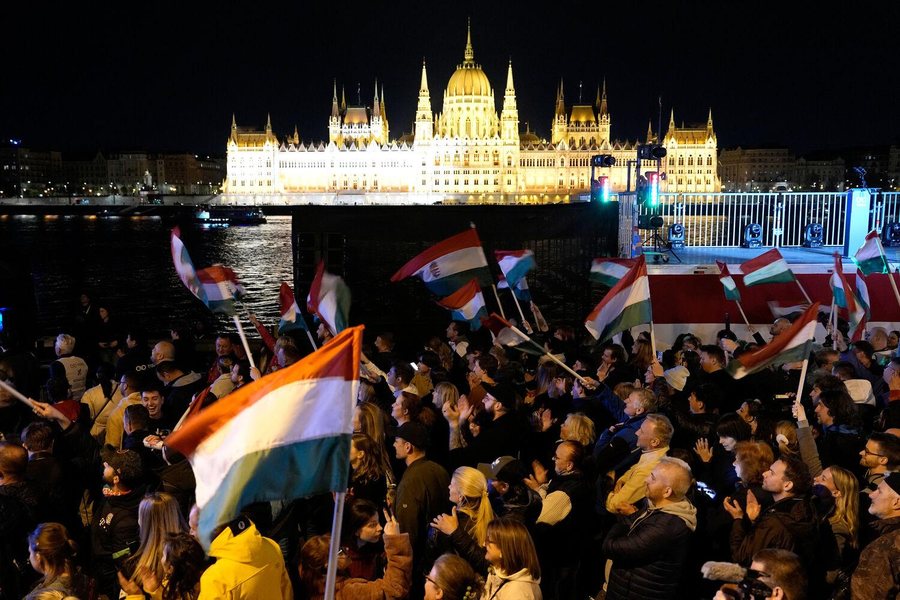
We were expecting some dirty trick from Orbán until the last moment, there was anxiety whether Orbán would give over the power peacefully if defeated. That’s why relief and euphoria were so big on election day. On Sunday evening the crowd erupted in ovation and clapping when we saw on the screen that Orbán congratulated Péter Magyar, the cheering became even louder, when they announced the 2/3 majority of the Tisza party.
It was a euphoric moment. People were hugging each other, smiling, laughing, dancing in the streets of Budapest and all over the country. It was a moment of realization that democracy works indeed, that our vote really counts, no matter how rigged the political system got under the Orbán-regime. It was hard to believe after the 16 years of Orbán-rule that it is really over.
And it took a while to digest this pivotal moment that a new era has finally begun in Hungary.
On Monday afternoon, the day after the elections, watching the first international Press Conference of Péter Magyar was a new experience; a press conference where independent news outlets could participate, ask questions and they got real answers. We have already forgotten this type of normalcy; we must get used to it again.
In the meantime, Fidesz politicians were ghosting away, some lower rank people started to blame Viktor Orbán for the defeat, some left public life immediately, but all puzzled. Orbán himself didn’t resign, he said he wanted to continue to rebuild his party now that the pressure of governing is not pushing them and then disappeared for a few days.
He ghosted the European allies, as well, as neither him nor Szíjjártó, the outgoing foreign minister, participated at the informal European Council meeting in Cyprus. Probably it was also better this way for everyone. Later, he even ghosted his own party members, as he announced that he wouldn’t even sit in Parliament.
On April 18, the final results were announced; 141 seats for the Tisza party and altogether 52 for Fidesz, 6 for the Mi Hazánk (Our Homeland) extreme right party. Fidesz won only 10 out of 106 individual election districts. Tisza has 70% of the seats in Parliament, a landslide victory.
What do we inherit from the Orbán-regime?
The deficit until April reached over 80% of the yearly forecast, Orbán-close oligarchs owe the most prestigious hotels, historical buildings in Budapest, a big proportion of land all over the country, castles, hotel chain, the biggest construction companies and others, including the biggest bank.
Orbán built up a luxurious estate for himself in Hatvanpuszta, his son-in-law has become one of the richest persons in Hungary. Democratic checks and balances are emptied; Fidesz-close functionaries are sitting on the top of would-be autonomous institutions including the national prosecutor and the members of the Constitutional Council.
The state is indebted, polluting battery factories are mushrooming in the country, there is high dependence on Russian fossil energy. Society is divided, families and couples split because of differences in political convictions.
Some people fear that there is no “leftist” party now in the Parliament, but in the electoral system designed by Fidesz, Tisza’s main task was to break down the regime, the electoral law was not designed to allow democratic diversity and pluralism.
Now, we are at the beginning of a long and bumpy road; to dismantle the Fidesz crony structure, to hold the guilty accountable, to deliver justice, and to restore liberal democracy, to build up a more resilient system of check and balances not to allow an authoritarian turn again.
But Péter Magyar’s Tisza party received the highest ever democratic authorization from the people to do it.
Hungarians understood the stakes of this election, and we made an unequivocal decision on April 12th, 2026: Hungary’s place is in the European Union.
What are the main take-aways of all this for other countries still living under authoritarian rule?
- Authoritarian leaders always use intimidation; this is one of the most important tools to paralyze people. Fear discourages from acting and self-organizing. When mass protests have already begun it is a sign that the people have had enough, and they realize that passivity won’t bring any change. Apathy and passivity serve above all authoritarian leadership and maintain the status-quo.
- Another important tool of authoritarians is to control public opinion by massive propaganda and silencing autonomous voices above all independent Media outlets critical of the government. The speed by which the former government party and its propaganda machinery are collapsing now in Hungary shows that all this was kind of a Potemkin village type of structure, by far not as solid as it seemed.
So, if the opposition forces get out of their isolated situation – via mass protests and social Media platforms for example -, they could have a chance to go against the authoritarian ruler.
- A widest possible coalition will be needed to defeat the authoritarian leader. Orbán had no chance to deny the election results when he saw how massive the Tisza party was supported by the people. He had also no chance to use force as neither the military nor the police forces would have gone against the people, so he had no other choice but to congratulate the leader of the opposition shortly after the announcement of the first results.
This coalition in Hungary was not a coalition of parties, but a coalition of people of very different background but strongly wishing the end of the Orbán era.
- Involvement of young voters was a crucial and decisive factor in defeating Orbán. This part of the society was the least supportive of Fidesz, but they were also the most reluctant to go to vote. So, the main task was to motivate them to participate in the elections and cast their votes. Influencers and civil organizations did a great job in achieving this.
- In the countryside, vote-buying was a considerable phenomenon. It was probably the most questionable whether these people would realize the power of their ballot, and most importantly whether they would dare not vote for Fidesz despite all kind of pressure coming from the ruling party.
There was a documentary film coming out a couple weeks before the election date, The Price of the Vote that described these methods and how marginalized people were blackmailed to vote for Fidesz. It had a great impact, and civil activists organized themselves to go to the countryside and not only be inside where the ballots are cast, but also watching the surrounding area outside for suspicious moves.
It also had an important impact on the election results by discouraging the Fidesz agents and encouraging the citizens to vote freely.
- Efficient opposition would need to set up a structure to build up a political party and reach out to the marginalized people. Péter Magyar consistently toured the countryside throughout these 2 years running up to the elections.
On purpose, he didn’t focus on bigger cities, as they are on one hand more liberal, better informed and more critical of any authoritarian government, on the other hand people in smaller dwellings are usually marginalized, ignored by politics and in the same time because of the existential vulnerability of their citizens they are also more supportive of an authoritarian leadership.
And of course, less educated marginalized masses of people outnumber the more critical intellectuals living in the capital almost in every country.
All in all, it might seem to be more efficient to campaign in the capital and bigger cities, but the tactics of Péter Magyar focusing his rallies on smaller places in the countryside paid off. And he did a very intense campaign in these 2 years; he visited around 6-700 places.
- Péter Magyar actually talked to people and more importantly also listened to them during his rallies, he talked in public open-air, and he was approachable for everyone; people could ask questions, share their stories, their grievances freely. He himself admitted that he had learned a lot about the country, the people and the real problems during this time.
People had the feeling that they were listened to and this proved to be magnetic, there were bigger and bigger crowds gathering every time, even in former Fidesz stronghold. It was also in sharp contrast to Orbán’s campaign who appeared only in closed placed in front of selected people.
- Péter Magyar proved his good will and authenticity during these rallies by his rhetoric skill, his enthusiasm and charismatic appearance, as well. To go against an authoritarian leader with a “personal cult”, you’ll need another “leader type of person” first.
In my opinion there is no direct transformation into a liberal democracy after decades of authoritarian rule. You’ll need a transitory period, and some needs to take the leadership role, who can break the myth of the authoritarian leader.
Real democratic transition can only start after breaking with the old ruler, and opening up the ground for real democratic competition after eliminating corruption, creating transparency in the state administration, the judiciary system, and all other state-controlled areas.
Eszter Nagy is an economist with an MA degree in foreign relations from CEU. She served 12 years as a diplomat. Since 2022, she has been a local councillor in the Budapest 2nd district council. She has been a member of the Hungarian section of European Federalists since 2016, she is the president of this local section, and a member of the UEF Executive Bureau since 2022. She writes articles for the Federalist Debate organizes and participates in panel discussions related to European affairs and democratic resilience.