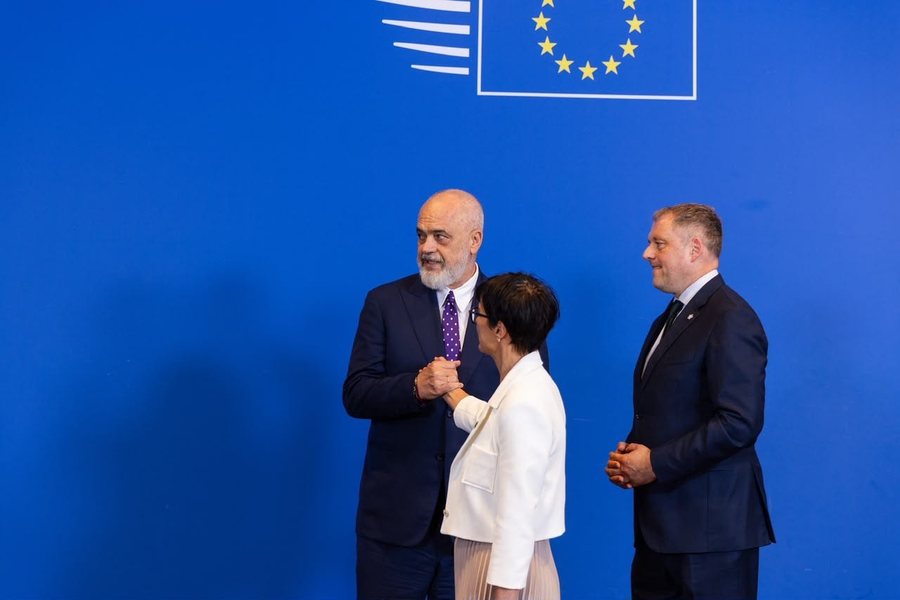
During a press conference in Brussels on July 14, together with EU Commissioner for Enlargement Marta Kos after the ninth Albania–EU Intergovernmental Conference, Prime Minister Edi Rama made several comments with regard to his ideas about the EU legal framework, also known as acquis communautaire, that should raise alarm bells within EU capitals and Albania.
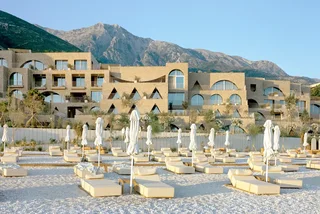
When referring to the “strategic” development project in Zvërnec, which provided the initial spark for the massive popular protests throughout the country, now going on for more than forty days, he said the following:
You will realize there is nothing to worry. The project is still a work in progress. The project is nowhere to be seen so far, because it has not been finalized. An environmental impact assessment is ongoing. Everything is being done by the book since day one. It doesn’t matter the names. Naming names is not something that helps us get to the truth.
And when I say “by the book,” there is only one book for us that counts, which is the European Union accession book and the European standards book. So just the idea that Albania and the Albanian government would go forward with something that is not in full compliance with the holy book of religious [people] and atheists in Albania, which is the European Union standards and principles is preposterous.
So there is nothing to worry. Zero. We will do a project that will be the subject of pride for Albania and for Europe, and this is my ambition. Albania should make it happen for itself and for Europe. And of course in the process we will be, as we’ve been until now, very very rigorous in asking nothing but the highest standards, nothing but something that will make everyone proud for having this thing in the middle of Europe. Otherwise it will not happen.
This statement contains several falsehoods.
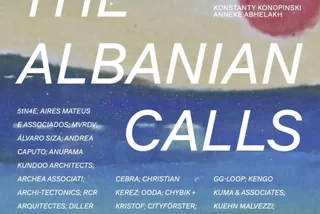
First of all, the project is certainly “seen” in the massive environmental damage already caused in Zvërnec as evidenced and documented by more than seventy environmentalist organizations, and which has raised concerns within the European Parliament. The project is also part of the propaganda publication The Albanian Files, which has become a key document in evidencing the deep relations between real estate oligarchs, drug trafficking, international architects, and the prime minister.
Then there is the issue of “naming names,” such as pointing out the involvement of Jared Kushner in the Zvërnec development or the involvement of architect Marco Casamonti or oligarch Shefqet Kastrati in its feasibility study. Naming names, in fact, is crucial to establishing the truth, as it allows us to trace institutional and personal accountability. Naming names, indeed, is essential for justice.
Second, and cause of much greater concern, is Rama’s reference to a “holy book” of “European Union standards and principles.” First of all, such a “holy book” does not exist.
There is a codified EU accession procedure led by the European Commission, and there is an EU acquis communautaire, a legal framework, with which Albania is expected to harmonize its own legal framework during the accession process. Both the accession process and acquis are in no way “holy” in the sense of unchangeable, unassailable, or immune to criticism. In fact, the history of EU accession shows quite the contrary.
However, by declaring the EU rule of law framework “holy” Rama does two things:
- Disempowering the Albanian people and Albanian parliament. This is a common strategy that Rama has employed for over a decade, most importantly during the implementation of the Justice Reform legislation. By means of claims that “EU demands x, y, or z,” he has insistently bypassed proper parliamentary deliberation around key legal provisions, which in turn has significantly weakened Albanian rule of law and parliamentary oversight.
- Allowing legal loopholes with the argument “the EU doesn’t require us to do so.” If the “holy book” tells you it’s not prohibited, you can do it. This was most recently made quite clear in the responses of the minister of Environment, who implied to members of the European Parliament that works in Zvërnec would continue until Albania was obliged to comply with EU standards. Albanian ministers should not just comply with EU standards; they should also listen to their constituents and should do so more than once every four years.
Finally, by declaring a set of secular legal texts a “holy book of religious [people] and atheists in Albania," the prime minister offends both religious people of any denomination, who already have their own cherished holy books, and atheists, who reject the existence of any holy book whatsoever. If anything, his statement shows the striking ideological continuity between the communist dictatorship and the currently ruling political class.
Shpërndaje te miqtë