The release of The Albanian Files has provided more than anecdotal evidence that international architecture bureaus are intimately linked, through their self-professed direct access to Prime Minister Edi Rama’s monopolized decision-making power over the Albanian territory, to a structured criminal enterprise that encompasses drug trafficking, money laundering, oligarchic territorial capture, and the destruction of the Albanian landscape and natural resources.
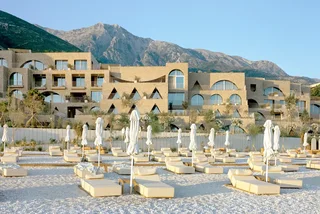
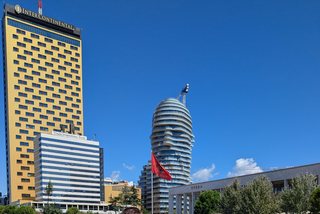
In this book, as has now been widely discussed in a variety of Albanian media, they openly proclaim Rama’s ability to put them in touch with wealthy oligarchs to build towers and beach resorts, bypassing the environmental or building legislation that local, Albanian architects are expected to strictly follow. While they boldly claim to love Albania’s natural landscapes, their projects show a very different attitude.
The Albanian Files is a celebration of a caste system, where foreign starchitects have the freedom to do as they please without accountability or consequences, while local architects must suffer what they must.
However, The Albanian Files is not the only document that allows us to map out the professional practices of international architecture firms in Albania.
The Albanian Files was edited by Anneke Abhelakh, founder of the “Studio for Unsolicited Architecture.” She also happened to be the curator of the Albanian pavilion “Building Architecture Culture” at the 2025 Venice Architecture Biennale, commissioned by the Minister of Economy, Culture, and Innovation Blendi Gonxhe (without any public call or competition).
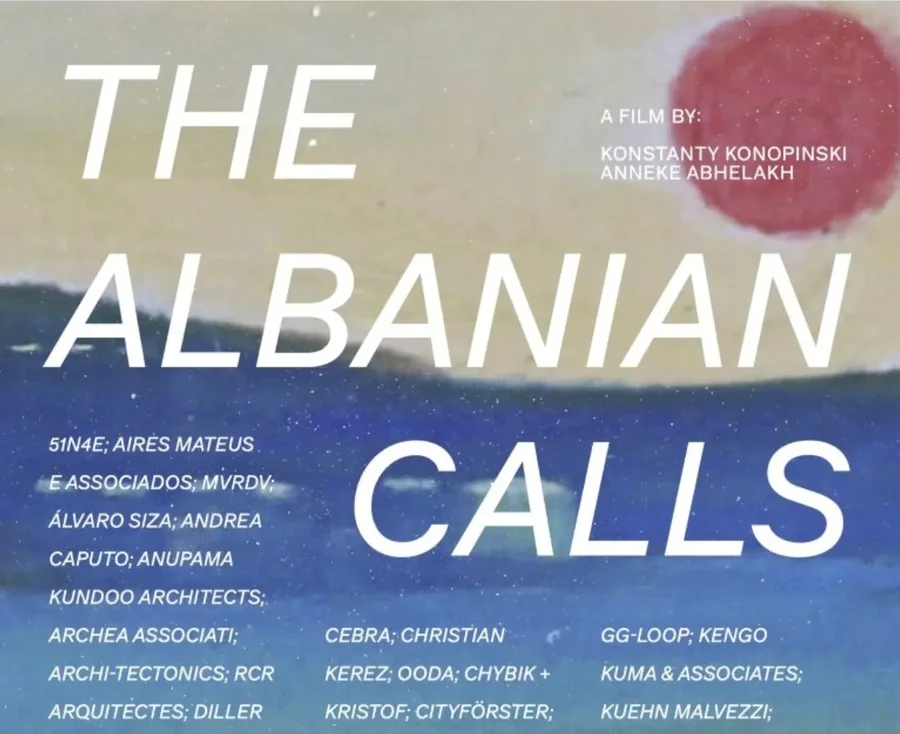
Many of the architecture studios that contributed to the pavilion and The Albanian Files publication are also featured in a “feature-length video essay” accompanying the exhibition: The Albanian Calls (2025).
To get a sense of the attitude displayed by most architects in this film, let us start with some brief quotes: “They don’t have a concept of normal in Albania, […] there is an enormous freedom working there,” Peter Wilson (aka the defacer of Korça) entrusts us.
But that “freedom and the trust are intoxicating,” his colleague Mikkel Frost, designer of the megalomaniac Mount Tirana) adds to the webcam.
So let us listen to how these architects get high on their own supply.
The Albanian Calls contains excerpts of over thirty video calls that Abhelakh held with international architecture studios in preparation for the Venice pavilion, interspersed with archival footage from the films Shqipëria Turistike by Mark Topallaj (1974) and Shqipëria 1991 by Xhovlin Hajati and Reiz Çiço (1991).
The inclusion of this footage is functional and important, as it avoids the need to show any moving images of Tirana or the Albanian coastline as it exists today. Showing the actual work of any of the featured architects would severely undermine the purpose of the film, namely to showcase and celebrate “progress.”
The opening story, by Pablo Bofill, introduces the audience to the curious mechanism by which many of his colleagues have come to Albania:
And I always remember this story, the first day that I just received a Google email kind of email saying, I have a big land and I have a big project in Albania, I would like to meet you. And I remember me answering right away and saying, even if it seems to be fake, because there is no, I mean, the modern life we’re all used to have kind of brands and people behind websites, everything. And in this case, I didn’t have any of that. I just answered, please, please come. I mean, the guy was saying I would like to come and I said, are you free on Monday? It was Thursday or Friday.
And the guy answered, yes, I’m available on Monday, I will be in the office on Monday. The guy came and he was sleeping in a very bad hotel right nearby the office here in the suburbs of Barcelona. And he came and the story started like this.
Big land, big money, no website, and a very bad hotel. Sounds very reasonable indeed. We can read this anecdote from The Albanain Calls next to Bofill’s other origin story, as documented in The Albanian Files. When asked how he was introduced to Albania, Bofill writes on that occasion:
We were first invited by Edi Rama to what we thought was a meeting with a politician. We arrived at a formal building where, quite quickly, it became clear that we were in fact meeting with an artist. Edi took us around the place as if it were an open studio, explaining the history of the city and the country as we went, surrounded by his and others artworks.
So here we have two anecdotes of Bofill “encountering” Albania, each with their own problems. But the results of Bofill’s dreams are clearly documented, even though he omits his clients’ names from The Albanian Files.
Let me list just two: vila "No. Red", designed by Bofill for Rama’s government, is shrouded in a cloud of abuse of public funds, and his Barcelona Tower is the property of oligarch Besnik Bami, who is mentioned in the Special Prosecution (SPAK) case file on Deputy Prime Minister Belinda Balluku as the recipient of underhanded government tenders.
This is what we call living the dream!
Another classic story is served by Winy Maas from MVRDV, who opens every single lecture on his work in Albania with romanticized ideas about Albanian coffee culture (so I will skip that for now) and then says:
And there was meetings with many friends and people and talking directly about not only architecture but also about what the state should be, how do you deal with housing, how do you deal with the occupied lands, say the non-ownership of the lands. And then [Rama] immediately asked, how would you solve this? And I said, I’m an architect. Interesting.
Indeed, “interesting,” because Maas is an architect and not a specialist in Albanian property law or the details of land redistribution during the communist period.
And of course, Maas has no idea how to solve any of this, nor has he made any concrete contribution to doing so. Instead, he built oversized towers for oligarchs such as Shefqet Kastrati, who is linked to the Zvërnec development, which is currently under investigation by SPAK.
But the point is this: Rama feeds into the inflated egos of these architects, making them think that they actually contribute to the advancement and development of Albania.
What they fail (or refuse) to understand is that that development only profits a very small class of people, namely those whose towers and resorts they end up designing. Everyone else suffers from inflated property prices and the rising cost of living.
Some architects have been able to grasp that there is indeed an economical component to all of this, but none seem to understand exactly how. Sam Chermayeff, who designs highrises for an abusive construction company linked to Socialist Party MP Xhemal Qefalia, says:
And now that I know it a little bit, just the idea that you can also raise money that way for the whole system. I’ve come to understand that the whole system is partly about housing, but it’s partly about Edi bringing money into Albania. It’s about taking, right? I mean, that’s really what it’s about.
He loves architecture and he’s combined something he loves with something that brings money for the state, which is really important. And I generally believe in the state and I believe in Edi’s [pauses, grabs his nose, looks away] socialist position. And at first, it seems like a crazy neoliberal thing, but it’s not. It’s like that our clients have to pay tax. We’re here because they have to pay 12 percent tax when they get a building permit. On the actual selling price of a building that hasn’t even been drawn up properly.
One really doesn't know whether to laugh or to cry when hearing grown adults speak like this (“socialist position”?!?!), but unfortunately for us Chermayeff is not done with his “analysis”:
They are taking outside investment and turning it to fund the state. And that’s really, really simple and a really, really smart thing to do. And if you think about it that way, it on the one hand sounds insane and risky. And it is insane and risky. Right. Like urbanistically, we don’t really I don’t know what these 64 projects are going to do.
You know, you could argue like, hey, we should build the roads first and the buildings later. But if the buildings are paying for the roads, right. So… I think in the end, you know, surely there’ll be some ugly things and some urbanistic situations that won’t work out. And I hope that I’m not party to those.
Chermayeff knows that the urban transportation grid of Tirana and its absent public transport system cannot possibly sustain the increased density brought on by the highrises he designs, but, hey, he “hopes,” like, not to be “party to those […] ugly things.”
He speaks of "urbanistic situations that won’t work out” as if they were a small nuisance, while the citizens of Tirana, of course, know they will be stuck with nonfunctioning infrastructure, lack of 24-hour water, and endless adverse health effects for decades to come.
Olga Bolshanina, whose Herzog & de Meuron decided to renovate the Palace of Congresses by building a tower on top of it, indeed has “a bit of a fear that they will have enough inhabitants to fill all these residential towers.”
Despite themselves, some architects get remarkably close to the truth. For example, Jeanne Gang, who designed a shining high-rise building to be built in the middle of Tirana’s last remaining oasis, the Artificial Lake Park, says, "It's not like a country that has so much wealth that they just want to park their money somewhere in architecture and use architecture, like just as some kind of glitzy marketing thing.”
But this, of course, is precisely what high-rise architecture in Albania is (besides a money-laundering vehicle): a “glitzy marketing thing” for Rama to claim the image of progress while selling off Albania from under its citizens' feet.
Matteo Frangi of 51N4E, the OG archi-exploitation firm in Albania, gets a bit closer but forgets the proper word:
But his move is a political move where you ask for the best architects in Europe to do things. And in the moment, you are… somebody is against you or wants to complain about what you’re doing, you can clean your hands, saying, look, I called the best architects, who are you to judge what the best architect does? So it’s also a matter of ehhh ehhh… How can you say it?
…Propaganda, Matteo, that’s the word you’re so desperately looking for.
Besides revealing how intertwined the practices of these international architects are with Rama’s political program, as well as the terrible delusions of grandure from which they collectively appear to suffer, what comes through in all their conversations is the enormous influence of the prime minister on the entire process of shaping Albania’s urban and nature landscape, an influence that is fully beyond the limits of the rule of law.
Elizabeth Diller speaks rightly of a “curatorial strategy”:
And that’s what differentiates Edi Rama, maybe from other politicians, is that he’s an artist. So he gets it. He’s not that different from the people that are collaborating on making the architectural work. So in a sense, there’s a kind of curatorial strategy that the prime minister brings.
And this curatorial strategy entails the involvement of the prime minister, who is supposed to run the country, in the deciding on the height of a lobby, as Wilfried Kuehn reports:
You know, the politicians side with the bankers in Frankfurt, and you will have a three-meter lobby. And in Tirana, you have a prime minister who gives you support and says we have a six-meter lobby.
Architects indeed don’t present their design just to the developer. As Charles Renfro (who works with Diller) readily admits, Rama actually inspects all designs personally.
José Selgas says: “So that’s why I think Edi Rama has got the power in that sense. And he said, OK, no more garbage. If you do it, it has to be in my way. And I think that’s a good movement.”
Time and again, Rama is featured as the protector of architects against the violent forces of market capitalism.
Here we have Chris Precht, who designed for an undisclosed sum of public money Rama’s private “Garden of Eden”: “In any other country, you know, you are eaten by sharks. And here you are, trying to be eaten by sharks, but you are behind the glass. And that sometimes helps a lot."
And Diller again: “I see this sort of interesting tension and negotiation that happens really between the PM and the developers to do the right thing.”
Does any of these architects ever wonder what happens in these “negotiations” between the prime minister and developers? Do they ever wonder—if even for a moment—whether that is a healthy thing to happen in a democracy in the first place? No, they don’t.
Wilson, one of the first to work in Albania, is quite clear about the architectural class system that has developed under Rama:
I think that’s the advantage of Albania, or maybe it’s a privilege we have as foreign architects that we can cut across these different levels between being practitioners and then talking to the politicians who can single-handedly make decisions. When I tell other architects in Germany about the planning process in Albania, they’re so envious.
And there’s two parallel systems. One is that you make an application to the normal planning office, and it’s a very long process. And then there’s limitations from the national regulatory plan. What can be is you go straight to Edi Rama. And if he likes it, then it gets a permit.
Olaf Schmidt (who designed another skyscraper for oligarch Kastrati) concurs:
I think the whole dynamic is very interesting and unusual. I’ve never worked in quite the same framework before where you have a client, but then you also have a person like Edi Rama being essentially the kind of driving force who sort of makes the developers choose certain architects as a condition of building or building a certain size on the sites that are available.[…]
I mean, I think in terms of our specific site, what we heard is that the existing zoning permits only a five-story building. So anything beyond that would require a special permit. I don’t know the exact mechanism by which that would ultimately happen. But clearly, Rama’s blessing is a key aspect there. […] One man, so to speak, can make it happen, right?
Martin Sobota of Cityförster, who worked on Gjikuria’s project in Drymadhes, offers succinctly:
There is an approved master plan, which defines the density, which defines the functions. So you have all the coefficients, and that’s in the south, but that’s also in Tirana. But actually, it’s not relevant for your project because everybody can get an exception.
The exception, of course, comes directly from Rama. An unidentified Asian architect confirms this, laughing all the way:
Edi Rama, he basically at a certain point said, the developer wants to build 90,000 square meters of floor area for this 13-point-whatever hectare site. And then he kind of quickly calculates in his head, and that’s too much. He said, don’t listen to the developer. What is important is what you think is beautiful for the site. And he’s like, "I think it should be about 50 or something, half like that."
So I was very stunned at how this is, like, is this for real? You know, this doesn’t happen in a capitalistic world.
Indeed, it doesn’t. Nor does this happen in a functioning democracy. If Edi Rama is indeed the “driving force” that can make developers “choose certain architects,” one really needs to wonder with which power he is able to do so.
This power is clearly beyond the rule of law, beyond the rules of fair competition in a market economy, and only very few explanations are available as to why and how Rama has been able to act in this way.
It is for the Albanian judiciary (and all the judiciaries in the countries in which above-cited architects operate) to find out.
Shpërndaje te miqtë