The Albanian Files, which has turned out to be the seminal publication chronicling the backroom dealing that has defined Albania’s construction boom, continues to make waves.
In Albania, both activists and the opposition have presented the book as evidence in criminal complaints against Prime Minister Edi Rama, who also heads the National Territorial Council (KKT), at the Special Structure against Corruption and Organized Crime (SPAK).
Albanian architects have joined together in protest against the exploitative practices of international firms, unifying as Arkitektët Shqiptarë (The Albanian Architects).
One of their projects has been the analysis of The Albanian Files, correlating the information contained in its pages with public procurement data, extant masterplans, KKT decisions, and so on.
This is incredibly valuable research and lays the groundwork for mapping the scope of the crimes committed (which no one really doubts at this point).
But this time, the turmoil is no longer only limited to Albania. For the first time in nearly two decades, the criminal money, corruption, and nepotism have found their way back to one of the founts of Rama’s lust for starchitects: the Netherlands.
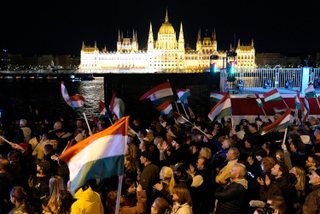
The backlash started with an article in daily newspaper De Volkskrant on July 10 about how the Flamingo Revolution protests in Albania had also turned against Dutch architects.
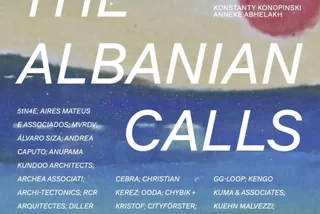
This was followed by a review on July 13 published in July on the Dutch architecture portal Archined by Albanian architects Klodiana Millona and Dorina Pllumbi, both working in the Netherlands, of the presentation of the companion documentary The Albanian Calls in Rotterdam.
In their review, Millona and Pllumbi link the documentary and publication directly to the source of the anger expressed by thousands of Albanians already for a hundred nights straight: the wanton destruction of Albania’s natural and cultural landscapes funded by a seemingly unlimited influx of mafia money and the utterly corrupt Rama government that is its cause.
In her response to the review, editor Anneke Abelakh, who also curated the Albanian Pavilion for the 2025 Venice Architecture Biennale, reverted to a vague rhetoric about the book being some sort of archive, which would contribute to narratives even as they shift.
What she of course ignores is the simple fact that “just documenting” “history” in an “archive” is not an automatic, neutral procedure, but extremely political.
All of this of course starts with the question of how Abelakh got to be curator, book editor, and documentary filmmaker in the first place. The political nature of her work as editor also becomes quite clear at the end of her response, when Abelakh writes:
The task of an archive is not to settle history. It is to make a historical moment sufficiently legible that it can continue to be questioned, reinterpreted and understood from different positions, including those that were not visible when it was first assembled. (My emphasis)
The “different positions” she refers to, namely the positions that are critical of the involvement of international architecture firms in Albania, were of course already visible when she assembled her book and held her interviews, if she’d know where to look and whom to talk to.
They were invisible to her.
But then again, she accepted all of this archiving labor about a country she self-admittedly “barely knew.”
Then, on August 24, Dutch architecture portal De Architect published a review of The Albanian Files (English version here) by architecture historian Wouter Vanstiphout, former professor of Urbanism at the Technical University Delft and currently involved in the Independent School for the City, which had hosted the screening of The Albanian Calls that Millona and Pllumbi had reviewed a month prior.
Vanstiphout’s review takes no hostages. It reads, from beginning to end, as an indictment of international architecture and in particular the Dutch architects involved with the Albanian narco-regime.
His qualification of the architects heaping praise on Rama: “useful idiots.”
After all, it requires a specific kind of stupidity on the part of architects to be able, 35 years after the fall of communism, to dismiss the corrupt chaos within which they work as the inevitable growing pains of a country struggling to break free from its past, and to view Edi Rama as the enlightened leader without whom the country could never reinvent itself.
The gauntlet is thrown.
Here is someone with a long track record at one of the most prestigious architecture schools in the Netherlands, who has been in discussion panels, conferences, and workshops with many of the architects involved, drawing a line in the sand. Yet from all those that Vanstiphout accuses of criminal acts of stupidity and negligence, we hear nothing: crickets.
Except for Abelakh.
Once again the curator/editor/filmmaker takes it upon herself to defend the indefensible.
The result, only available in Dutch and behind a paywall, is a bit of a painful read. Already the second paragraph suggests extensive usage of AI, and the rest of the text is less an argument than something that looks like an argument.
Not a single claim of Vanstiphout is countered, not a single piece of evidence adduced. The conclusion can be paraphrased as follows: “Your criticism makes a point, but I like to keep things open. Open is good. Yeah.”
Now that it has become quite clear that Abelakh alone is unable to credibly and forcefully defend the work of all the architects assembled in The Albanian Files & Calls, the question increasingly becomes: Where are they?
Earlier in the summer, some of them tried to enter the fray.
Martin Sobota of Cityförster wrote me a few increasingly alarmed emails, and he also tried to convince the Dutch ambassador in Albania to rein me in. Reinier de Graaf, the master-ironist of OMA, voiced his opinion safely from behind the paywall of the Tirana Times (no one reads the Tirana Times), teaching Albanians how important satire is:
Satire is a basic condition of political freedom. Without satire, a democracy loses one of its most essential instruments of self-correction: the ability to laugh at its own contradictions before they harden into dogma.
There is no lack of satire in Albania, as many of the protest signs in front of the Prime Ministry show night after night. What is no laughing matter, however, is De Graaf’s position as an architect working with contractors involved in massive money laundering.
Is that really the position from which you are going to teach the Albanians about satire and its value for democracy?
Perhaps De Graaf really believes that all critics are planted by the Albanian opposition and not worthy of a response, but where is the voice of that fierce, independent thinker who boldly claimed, “Architecture, as we know it, is in crisis”?
And what to say of intellectual heavyweights like Winy Maas or Bjarke Ingels, Stefano Boeri or Sam Chermayeff?
They usually have so much to tell us, about their visions and dreams, about the glorious future of the built environment, but now they seem unable to muster even the tiniest of defences!
What I think is happening is the following.
All these white men – because they are mostly white men – think: We are going to let this brown woman clean up our mess. Let her come out and defend us!
It will not be the first and certainly not the last time that people from minoritarian backgrounds are lifted up (Venice! Book! Documentary!) only then to be used as scapegoat when things go haywire.
That Abelakh is an excellent candidate for this position of scapegoat is, in retrospect, already obvious at the 2025 Bread and Heart Festival, where she is introduced as the “pepper” spicing up the blandness of the whole affair. This is how she introduced herself:
12 September 2024 was my first day in Tirana, ever. The first person I shook hands with was President Herzog of Israel. Shortly after that day, I fell in love with the [Skënderbeg] Square. So, you ask me to bring pepper. Everyone else was asked to bring salt. Maybe it sounded playful, maybe it was.
At this point you think that she is gearing up to call out the blatant racism of asking the only woman of color to bring pepper. She continues:
But pepper has a history, it builds empires, it burns. It traveled oceans. You asked me to bring pepper perhaps unaware that centuries ago men wrote travelogs describing women looking exactly like me as malabar spice, a fiery, exotic creature. Prized, not like the salt of the earth, but more pricey than gold, shipped and traded like ingredients. This isn’t seasoning, it’s exoticization.
Ok, perfect. The point is made. Those white men should be ashamed of themselves. But then follows the unexpected conclusion:
So I accepted the challenge.
Bewilderment.
And there she is now, kneedeep in the challenge she accepted, knowing full well that the men who set her up for it are in the business of shipping the likes of her around like “exotic creatures.”
They are not coming to help her now, she has to clean up the PR mess of decades of corruption and money laundering that they facilitated, designed, and celebrated.
It isn’t a pretty sight, and it certainly still is a symptom of the white supremacy and colonial mindset that echo out whenever any of those men open their mouths, not in the least in Abelakh’s own documentary.
Shpërndaje te miqtë