At the invitation of Gjergj Konda, Former Minister and Deputy Minister of Economy, and his wife Laura, my daughter and I visited Albania in early September 2025. We landed at 10 p.m. at the bustling Tirana airport. Our hosts were waiting to drive us to their apartment. As we left the airport parking lot, we merged into heavy traffic heading to the city center. Visiting Albania after 34 years, I was shocked by the changes, wondering if I was in the same country.
In early 1990s, many countries in Eastern Europe and Central Asia began their transition to a market economy. From 1991-1992, I was the Albania Country Officer for the Word Bank, as part of the Europe and Central Asia Department, which was headed by Kemal Dervish. It was believed that some of Kemal’s ancestors were Albanian, so he had a soft spot for the country. He genuinely believed that the World Bank could have a tremendous impact because Albania had a small economy, was in the heart of Europe and had a well-educated population, ready to cooperate with international institutions. The country’s communist regime had collapsed in the early nineties, unable to sustain its failing economy. Soon after, the IMF, World Bank, EBRD, and other institutions and countries were in Albania, ready to help in its transformation.
On my first mission to Albania, I was shocked by what I saw: a landscape dotted with bunkers, empty streets except for a few old trucks spewing black fumes, empty shelves in the few open stores, primitive agricultural practices, and traumatized people trying to make sense of their new reality. Kemal focused on Albania so much, that our Department was jokingly referred to as the “Albania Department”. Experts, including the Bank’s chief economist Larry Summers, were consulted and missions were dispatched to work with the Albanian government on every aspect of the economy. We were housed in villas that formerly belonged to senior party officials, and our food was imported from Italy. On a visit to the Tirana Zoo, tears came to my eyes when I saw the emaciated animals.
Because of many visits, I got to know many of the officials and ordinary people. I fell in love with the Albanians because of their kindness, generosity, great sense of humor and history. They reminded me of my own people in the Middle East. Often, as I was about to depart, the guards at the airport would allow me to go on the tarmac and talk to arriving officials.
Thirty-four years later, I could not believe my eyes. The airport is no longer small, with one or two flights a day. More than 10 million passengers fly from Mother Teresa Airport in Tirana every year to all the main cities in Europe. The highways are wide with many cars and in Tirana you see high-rises designed by prestigious international architecture firms. Malls and casinos compete for space. Grocery stores were selling fruit, vegetables, meat and fish at very competitive prices. People were out everywhere, along with tourists enjoying the wonderful Mediterranean weather and the music in the large square in the center of Tirana with the statue of Skanderbeg, a 15 th -century military leader who defended Europe from the Ottoman invasion.
On a drive to Berat, we passed by several beautiful small towns. We finally reached Berat and climbed to the top of the mountain, where a well-preserved castle and our hotel stood. Berat Castle is a historical fortress with ancient origins from 4 th -5 th century BC. It is one of the few castles in Europe that remains inhabited and a UNESCO World Heritage.
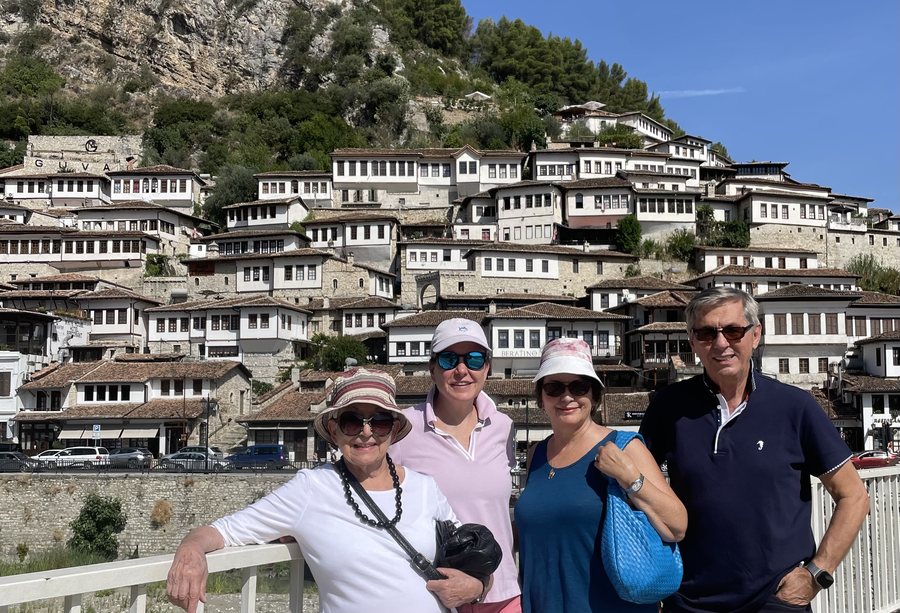
There were about 20 churches within its walls, most of them built during the 13 th century. That evening, the four of us had a sumptuous dinner with wine and beer for just $40. The next day, we descended the mountain, viewed Berat from the valley and enjoyed the city’s mosques, churches and unique tiered houses. Berat is also known as “the city of a thousand windows” because of its distinctive Ottoman architecture. We continued driving to Durres and were fascinated by the new buildings that had risen up along the sandy beach.
As I was leaving Albania, I bumped into three young ladies at the airport who had been hiking in the northern mountains. They told me that lots of hiking groups were all over the place. After what I had already seen, I was not surprised. Tourists have finally discovered Albania, its mountains, beaches, culture and affordable prices compared to Greece and Turkey. Jared Kushner is even planning to build a high-end resort on one of the Albanian islands.
While flying back to the US, my thoughts went back to Kemal and my other colleagues who had worked on Albania during its early years of transition. Even in our wildest dreams, we never thought that one day Albania would become the country I had just visited. I wonder if I will ever be able to afford to go to Albania in the future after more tourists discover that jewel of the Balkans.
October 2025
Shpërndaje te miqtë