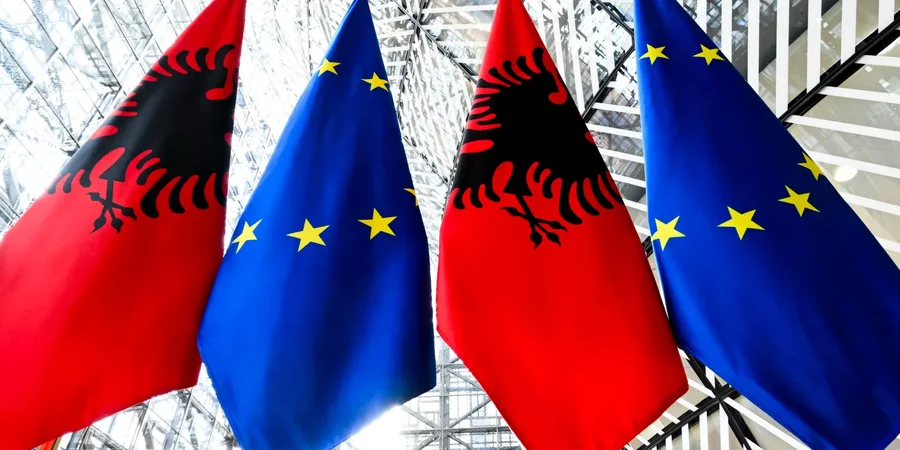
Almost all of us Albanians want to join the European Union — perhaps more than anything else. We wouldn’t mind to be admitted into the Union without strictly meeting membership standards.
The key question is: is the EU ready to accept us as we are?
The European Commission’s latest 2025 Progress Report on Albania does not give a clear answer.
It shows that the country has made some progress, but also that it remains far behind in several key areas.
On one hand, the technical report highlights the large gap that separates us from EU standards; on the other, political statements in Brussels and Tirana paint a much more optimistic picture — speaking of closing negotiations by 2027 and membership by 2030.
The truth, however, is more complicated.
What Is the Report and How Is Albania Assessed?
The 2025 Progress Report on Albania analyzes the country’s progress between 1 September 2024 and 1 September 2025.
It measures Albania’s preparedness across 40 different areas, covering all negotiation chapters with the EU — from the economy and the judiciary to the environment, education, and foreign policy.
The Commission evaluates two things:
- The country’s overall preparednes to become a member; and
- The progress made over the past 12 months.
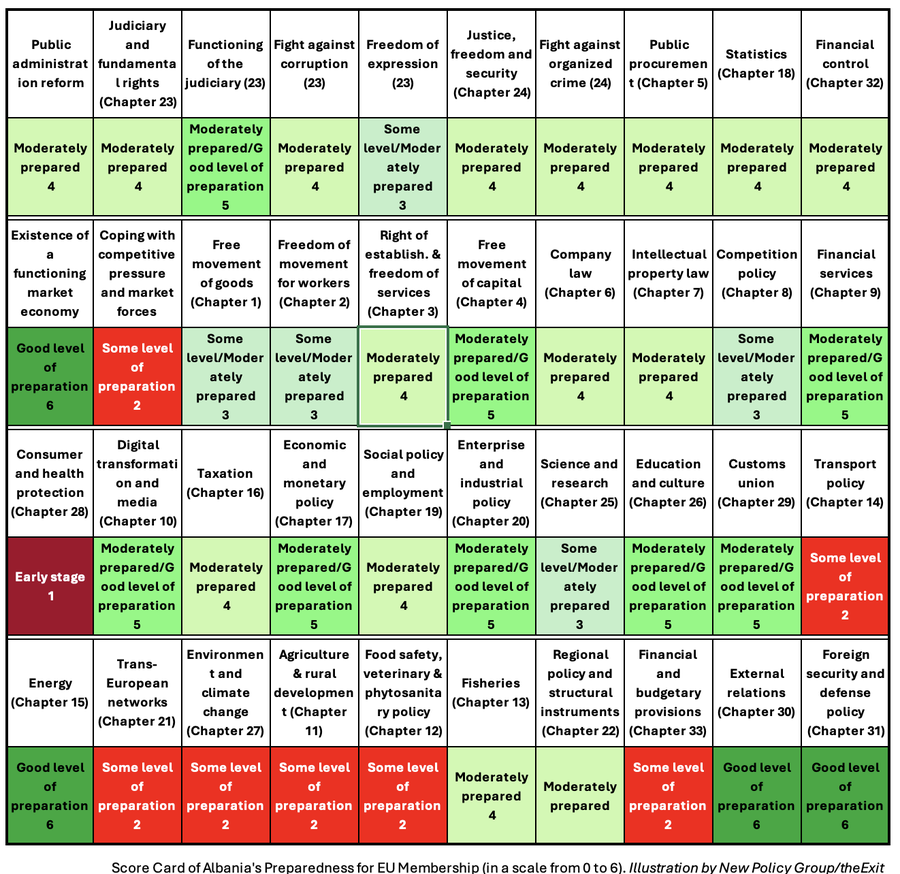
Preparedness is ranked on seven levels — from “early stage” to “good level of preparation.” Simply put, a “good level” means that a field is ready for EU membership, while “early stage” or “some level of preparation” mean that the country is still far from meeting the standards.
Where Albania Stands Today
According to the report:
- In 1 field, Albania is at early stage level of preparation;
- In 7 fields, it has a some level of readiness;
- In 5 fields, it is between some and moderate levels;
- In 15 fields, it has a moderate level;
- In 8 fields, it is between moderate and good levels; and
- In 5 fields, it has achieved a good level of preparedness.
Regarding progress during the last year:
- In 4 fields, no progress was made;
- In 9 fields, progress was limited;
- In 22 fields, there was some progress; and
- In 4 fields, good progress was noted.
Where Albania Performs Best
The report finds that Albania has reached a good level of preparation in five main areas:
- Foreign relations, where Albania consistently aligns with EU positions;
- Common foreign and security policy, thanks to NATO membership;
- Functioning market economy, which now operates with basic stability;
- Energy, where steps have been taken toward regional integration and diversification;
In eight other areas, Albania is only one step below the good level of preparedness. These include: judicial reform, free movement of capital, financial services, digital transformation and media, economic and monetary policy, industrial policy and entrepreneurship, education and culture, and the customs union.
Where Albania Falls Behind
On the other hand, the report shows that Albania is still far behind in several important fields.
Consumer protection and public health remain at an early stage — the country does not yet guarantee even the minimum safety standards for products and services.
Food safety is evaluated to have some level of preparation, due to the lack of laboratories, human and financial resources, and institutional commitment. The ban on Albanian fruit exports by some EU countries is clear evidence of this shortfall.
Environment and climate change stand at the same low level of preparedness. The failure of waste management and the incinerator projects are key indicators. The report raises concerns about the potential environmental damage caused by the government’s “Mountain Package” and related construction plans in mountain areas.
Agriculture and rural development have some level of preparation, as well. A major issue here is the mismanagement of EU funds and past scandals that continue to block financial assistance to Albanian farmers.
Transport and infrastructure are at e limited levele of preparedness, reflecting the country’s structural weaknesses.
Albania also has limited capacity cope with competitive pressure in the EU market forces, due to a lack of productivity, economic diversification and innovation.
In a few other areas — such as freedom of expression, free movement of goods and workers, competition policy, and scientific research — the situation is slightly better, but still between the low and moderate levels of preparedness.
Are We Close to Membership?
The report does not mention any target date for closing negotiations, nor does it refer to 2027. It offers only an objective technical analysis of Albania’s readiness.
In theory, a country should reach a “good level of preparation” in all 40 chapters to join the EU. In practice, the EU can make some exceptions, agreeing to allow certain standards to be met after accession.
Taking that flexibility into account, Albania is currently ready in about 12 of the 40 areas — those where it has either reached or nearly reached a good level.
In the remaining 28 fields, including 13 where preparedness is still low, the country remains far behind.
Misunderstandings About “Negotiations”
Public debate often treats EU accession “negotiations” as if they were true political talks between two sides. In reality, they are not negotiations at all.
The process is largely one-sided: the EU assesses each chapter, sets objectives — institutional, legal, and implementation reforms — that Albania must fulfill. EU reviews the progress annually, setting new objectives or reafriming unmet ones. The cycle repeats until Albania reaches a good level of preparedness and the chapter is closed.
In essence, “negotiations” are a process of evaluation and improvement, not a bilateral deal.
Another misunderstanding, spread even by Prime Minister Rama, is that EU accession depends mainly on translating and adopting EU legislation — a task, he claims, that artificial intelligence can accelerate.
In fact, legislative alignment is the easiest part of the process. The real challenge is implementation — building functioning institutions, strengthening the civil service, the economy, the judiciary, and ensuring that laws work in practice, not just on paper.
Geopolitical Hope and the Real Challenge
European Commissioners Kaja Kallas and Marta Kos, presenting the progress reports for Western Balkan countries, spoke of a “window of opportunity” for enlargement based on geostrategic considerations.
There is no doubt that there is now strong political will in the EU to admit at least some Western Balkan countries as soon as possible.
As they noted, Montenegro is first in line — and Albania follows immediately after.
This means that despite its technical performance, Albania might benefit from the the current political and geopolitical context.
However, both Commissioners and the EU Ambassador in Tirana have repeatedly stressed that EU support will come only if Albania helps itself — by undertaking genuine reforms.
The Year of Opportunity That Must Not Be Missed
The year 2026 will be decisive. If the Albanian government accelerates reforms and improves the implementation of EU standards, the country may seize this historic opportunity.
But if the current pace continues it will be difficult for the EU’s political goodwill to overlook Albania’s technical shortcomings.
For the sake of optimism, let us hope that this time will be different from the past 34 years, during which we have missed almost every opportunity to integrate into Europe.
Shpërndaje te miqtë