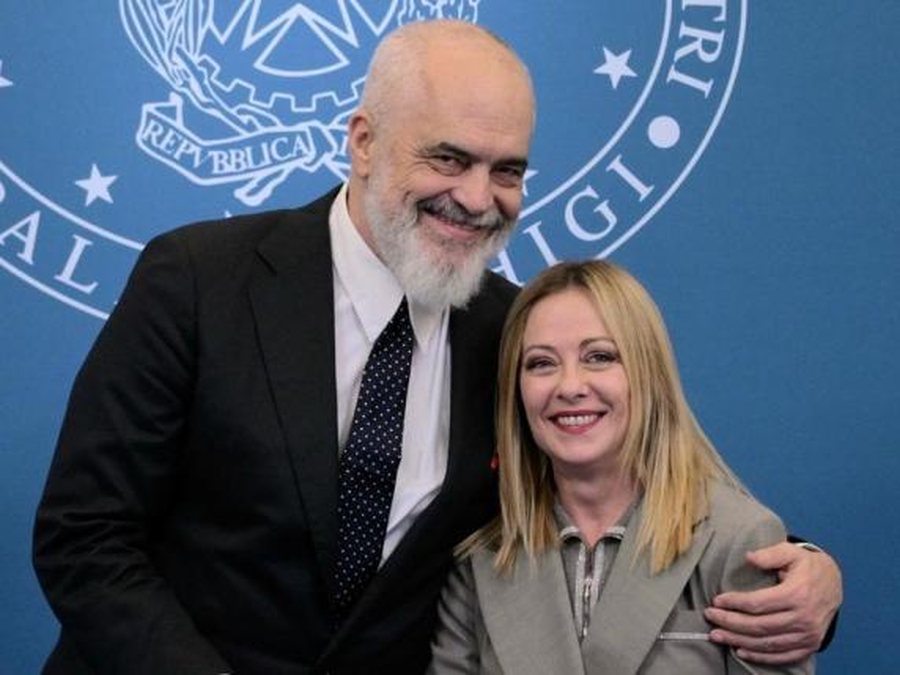
Albania and Italy and Albania held their first-ever intergovernmental summit in Rome today, signing several cooperation agreements and delivering a joint political message: the partnership between the two countries is entering a new strategic phase, anchored in defence, energy, and—controversially—migration management.
Prime Minister Giorgia Meloni and Prime Minister Edi Rama presided over the signing of more than a dozen accords covering health care, energy, environment, defence industry, education, innovation, diaspora, and migration policy. Both leaders described the day as “historic,” though for markedly different reasons.
Meloni: “Determined to Go Forward—Many Tried to Block the Albania Model”
Meloni used the summit to double down on her signature political project: the Italy–Albania migration protocol. She adopted a defiant tone, insisting that critics—political, judicial, and European—would not derail the offshore migrant-processing scheme.
“Determinati ad andare avanti. Many worked to slow it down or block it, but we are determined to move forward,” Meloni said, arguing that the model “has the potential to change the paradigm of migration management.”
She sharply criticised the two-year delay caused by legal and administrative hurdles, claiming that once the new EU Pact on Migration and Asylum enters into force, the Albania-based centres will work “exactly as they were meant to work from the start.”
The Italian premier also emphasised the strategic depth of the bilateral relationship—3,000 Italian companies operate in Albania—and signalled Rome’s desire to steer Albania’s EU integration process, ideally culminating in the start of rattification of Albania’s Accession treaty during Italy’s EU presidency in 2028.
Rama: “Italy Can Ask Us Anything—Others Cannot”
Edi Rama was clear in articulating Albania’s political alignment with Italy, casting the relationship in near-familial terms.
He referred to Meloni as “the big sister” — and framed the summit as the natural expression of a long-standing emotional and geopolitical bond.
Rama reiterated that Albania would only host migrant centres for Italy, and never for other countries: “With Italy, I would do this 100 times. With others—never. Because they are not Italy. We feel part of this country.”
On the migration agreement, he rejected any suggestion of regret: “How could we regret this? These projects serve Albania and Italy. They bring economic benefits and strengthen our defence capabilities.”
Rama also made headlines by declaring Albania is willing to join the EU even without veto or voting rights, and would accept representation through an Italian European Commissioner—an unprecedented concession from an EU candidate state.
“We are ready to sign an agreement not to use the veto or vote. We are fanatical believers in European values. We can even be represented by the Italian commissioner.”
The statement signals a dramatic escalation in Albania’s strategy: prioritising entry into European structures over formal institutional power, and placing Italy as its primary sponsor.
Defence Industry Breakthrough: Fincantieri–Kayo Joint Shipbuilding Project
A key announcement concerned the establishment of a joint Italo-Albanian shipbuilding venture at Pashaliman, involving Italian industrial giant Fincantieri and Albanian firm Kayo.
Rama confirmed that seven vessels will be built in Albania, calling the project a generator of “jobs, knowledge, and strategic capabilities” — and hinting that the ships could serve Italian, Albanian, or third-country defence needs.
This move significantly elevates Albania’s profile in regional defence production and signals Italy’s intent to anchor part of its military-industrial chain across the Adriatic.
A “Historic Day” but No Guaranteed Historic Consequences
Today’s summit may end up being more than ceremonial. In a way it marked a structural tightening of Albania–Italy relations across strategic domains: defence, migration, energy, and European integration.
But the power dynamics are clear: while both sides describe the partnership as “brotherly” the practical implications point toward pragmatical politics: Italy is using Albania as a partial solution for its migration problem, while Albania is counting on a fast-track EU accession through Italian support.
The coming years will reveal whether this model becomes a blueprint for the EU’s migraton managment and a model for dealings with candidate countries—or a cautionary tale of political overreach on both sides of the Adriatic.
Shpërndaje te miqtë