***
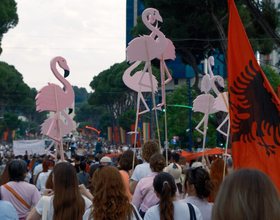
From this position, I notice that the discourse around whether Lulzim Basha is credible or not has been placed in the center of the recent debate. The majority, headed by Edi Rama, has until today played the card of devaluing Basha, propounding the thesis that PD's true leader is Sali Berisha, which, Rama tells the Albanians, they have tried already twice. The protest has raised Basha's profile by concentrating all the attention on him, so much so that it seems that its success or failure will also determine the fate of the future leadership of the PD. Considering that we are at an important moment, not only for the PD, but also for the Albanian democracy, I would say that this debate about whether or not the PD is credible or what needs to be done for it to grow needs to continue. In this text I am touching upon a point that I consider even more important, but which seems to be bypassed with an incredible ease. I am talking about the fact that, while on the one hand we are talking about the risk for democracy, we, on the other hand, at the moment that we're talking about saving it, paradoxically refer – both those who support and those who devalue him – to the figure of the leader. This because for ages we have reduced important institutions, such as political parties, to their leaders. Even in the democratic world this phenomenon of the growth in importance and weight of charismatic leaders can be noticed, but over there there is concern about this fact, which is considered to be something negative, the result of the mediafication of politics. We, however, don't have any dilemma at all. It is enough to consider the spaces occupied in our media by the meetings and private dinners of Rama and Meta, such as the most recent one, to understand how much we have drifted into that direction. Everyone accepts it as normal that the important decisions about our fate are made during lunches or dinners with eel, fish, or cucumbers, decided between the two of them. But the others, why then are they necessary? What do they need their parties for, or their office, or their meetings with militants? Only as a facade, to lie to the people? Isn't the same thing happening too with Basha's tent?***
As an enthusiastic follower of the emergence of the Cinque Stelle movement in Italy, I have considered one of the main points of its mobilizing force to be the slogan "Uno vale uno" ("One counts for one"), which implied that this was a movement of all the disappointed citizens, whose voice was as important as the voice of any of its leaders. I got disappointed when I saw that Grillo began to impose himself as a guarantee for the coherence and morality of the movement, but still I think that its force, also today, rests in that unifying beginning. If we were to refer to the Albanian experience, the best moments as regards the trust of the people in its own politicians have been when there were movements, in which the existence of many figures, who at the time inspired hope, stood out. This was the case with the anticommunist movement, until Sali Berisha decided to impose his own cult upon the party and the state, drowning out democracy in the process. The same happened in the year 1997, until Fatos Nano, and later Ilir Meta and Edi Rama, personalized decision making by building the system of oligarchs and criminal groups that we have today. During these 25 years, our history has been one of the personalization of state institutions, the reduction of parties to a single person, the reduction of the media to a single owner, the reduction of justice (as we want to do today) to two ambassadors, which turned out to be the most effective way to facilitate the abuse of power, corruption, injustice, misinformation, etc., all the evils that Lulzim Basha today promises to fight from under his tent. In order to alter this course of history I consider it counterproductive to hasten the creation of the cult of a captain in a time that the PD seeks to extract energy and trust from the entire people in order to mess around with it. Similarly I view with skepticism the fact that new parties have come up, especially Blushi's, which want to build upon the cult of the individual. Nowadays, the movement to build a "second republic," as Rossi calls it, has a need for people that give the example of withdrawing from the cult of the self, from the calculation for the self, for the sake of the interests of society that don't stick to words, but act in order to prove them. Only they can banish the demon of authoritarianism, arrogance, and irresponsibility of the leader who sacrifices the country for his own interests, who has occupied Albania since its origin and will continue to do so. Only people unified in this spirit and through such acts can inspire the hope in the exhausted Albanians to jump on the boat and to give them energy to row, this time, into the right direction.