Parliament elected Justina Shiroka Pula, 72 years old as Kosovo’s new president early on Tuesday night.
Shiroka Pula is the first catholic woman elcted as President in a country with muslim population dominance.
The election followed a last-minute political deal that secured lawmakers’ approval of legal changes restricting the powers of Kosovo’s Specialist Chambers, the Hague-based war crimes court.
The ballot began just six minutes before a midnight constitutional deadline, with lawmakers racing to complete the vote on time. Failure to do so would have triggered the automatic dissolution of parliament and another early election — the fourth in less than two years.
Shiroka Pula secured 81 votes in the first round, exceeding the required threshold of 80 in the 120-seat legislature.
The Democratic Party of Kosovo (PDK), led by Bedri Hamza, had insisted that lawmakers first pass the amendments before electing a president. Prime Minister Albin Kurti initially demanded the opposite sequence.
After the two leaders exchanged proposals and responses through press conferences, a breakthrough came with Kurti’s final offer: he proposed Shiroka Pula, a former member of Hamza’s party, and agreed to hold the vote on the court law first.
The PDK submitted the proposal after the 16 September war-crimes convictions of former Kosovo President Hashim Thaçi and three other former Kosovo Liberation Army leaders.
The amendments sharply limit the jurisdiction of the Kosovo Specialist Chambers, cap prison sentences at 15 years, require that sentences be served in Kosovo, and make people convicted by final judgments eligible for presidential pardons.
They also narrow the court’s temporal jurisdiction to the period from 1 July 1999 to 31 December 2000, excluding the wartime years, and restrict its mandate to offences directly linked to alleged organ-trafficking operations at detention sites identified in a 2011 Council of Europe report.
Parliamentary approval alone does not determine whether the changes can take effect. Legal experts have warned that Kosovo must respect its international obligations and that the amendments could face constitutional review.
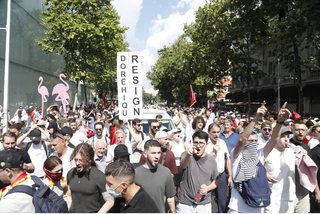
On Monday, the political deadlock and the failure to vote on the Specialist Chambers law led to clashes between angry protesters outside parliament and police. Protesters threw stones and bottles at the building while police used tear gas and water cannons to disperse them.
On Tuesday night, protesters gathered outside parliament and applauded as lawmakers approved the amendments before the election of the new President.
The presidency is mainly ceremonial position in Kosovo but has often been a source of political instability because a two-thirds parliamentary majority is needed to elect a president and parties have often struggled to agree on a candidate.
The new president, Justina Shiroka Pula, is an economist graduated at the Univercity of Prishtina at 1975. She holds a PhD from the University of Prishtina, along with postgraduate and postdoctoral degrees from the universities of Zagreb, Linz, and Arizona.
Shiroka Pula was the first woman to lead Kosovo’s Academy of Sciences and Arts, from the end of 2025 until yesterday, the day she was elected President of Kosovo. She previously served as minister of energy and mining from 2008 to 2011 and as a PDK member of parliament from 2011 to 2014.
Shpërndaje te miqtë