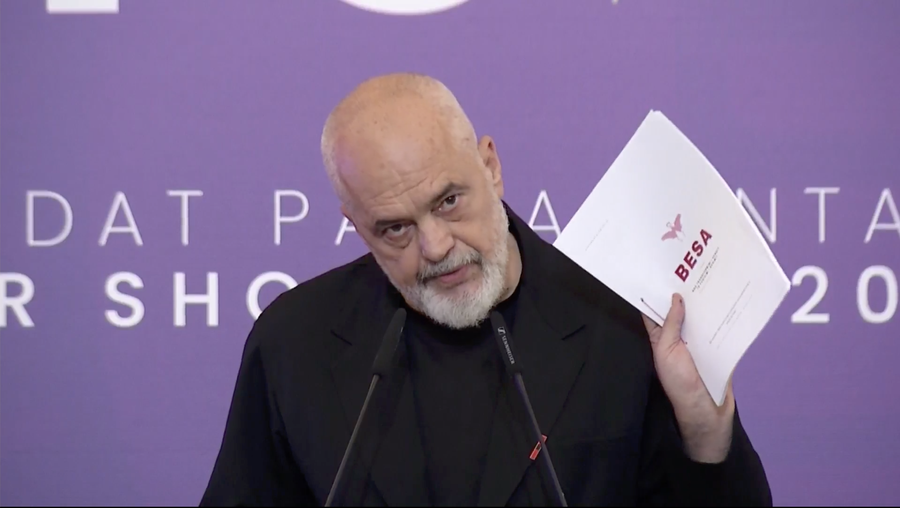
Last week, Prime Minister Edi Rama presented MPs and ministers with a strategic document outlining the approach the Socialist majority should follow during its fourth term in government.
The document, titled “BESA — from Transforming the Country to Strengthening Trust: The Turning Point of the Fourth Term,” sets out how government decision-making and operations should change in the future.
In the document, the Prime Minister directly acknowledges that, despite its large majority in Parliament, the Socialist Party is facing a crisis of public trust.
According to him, this crisis is mainly related to the failure of institutions to listen to, inform, explain decisions to, and respond to citizens.
Below is a summary of the document’s main points and proposals. The document is addressed to the government, the public administration, and the senior leadership of the Socialist government.
1. The Cause of the Crisis: “The Paradox of Success”
The Prime Minister presents the current public dissatisfaction as a consequence of the development and transformation achieved during the Socialists’ three terms in government.
To explain this, he proposes a theory he calls “the paradox of success”:
“The further a society advances, the less it judges what has been achieved and is working, and the more it focuses on what is missing and not working.”
According to him, poor societies are more tolerant of shortcomings because they are governed by the mindset that “things could be worse.” Albania has moved beyond this phase, the prime minister says, and entered a new one governed by the mindset that “things could be better,” in which society becomes increasingly intolerant of anything that is missing or does not work.
According to the document, the Socialist Party’s first three terms represented “the state that builds,” which radically changed Albania by focusing on physical infrastructure and the modernization of the state.
The fourth term should represent “the state that cares,” focusing on the quality of services, maintenance, citizens’ experience, and strengthening trust.
2. The “Besa Method” in Government
To strengthen trust, the Prime Minister proposes what he calls the “BESA Method.” This method is based on developing seven governing capabilities:
The ability to listen. The government must move from reacting to understanding. Institutions must understand concerns and detect signals before dissatisfaction turns into a crisis. Public hearings should therefore play a more important role in the government’s work.
The ability to prove. Decision-making should not be based solely on intuition or political judgment but on evidence and verifiable data.
The ability to explain. The government must move from communication to properly informing the public. Transparency should not be limited to publishing a decision; it should also include explaining why and how that decision was made.
The ability to care. The government must move from investment to the citizen’s experience. Everything that has been built must be maintained, while the quality of services and the resolution of everyday problems that citizens bring before the state must also be guaranteed.
The ability to measure. The state should not measure its work solely by what it does—laws adopted, projects completed, or budgets spent—but by the effect these have on citizens’ lives and their level of trust.
The ability to learn. Mistakes should not be seen only as failures. They should be analyzed to draw lessons and improve performance. The document proposes moving from a culture of blame to a culture of institutional responsibility.
The ability to anticipate. The government must move from managing crises to preventing them. It should detect signals coming from society in time and respond before dissatisfaction turns into a crisis.
3. Mechanisms for Implementing the “Besa Method”
For each of the seven capabilities, the document proposes a specific implementation mechanism.
The Listening Assessment. Structured public hearings should be held and analysed for every major reform or decision. The assessment should summarize citizens’ concerns, the groups most affected, the alternatives proposed, and potential conflicts.
The Evidence File. Every reform or strategic decision should be accompanied by a file containing the facts and evidence that justify it, including the alternatives considered, its expected impact, and possible risks.
The Explanatory Memorandum. Every reform or decision with a broad impact should be accompanied by a short document written in plain language. It should explain the problem, the reason for intervention, the chosen solution, what will change for citizens, and how the outcome will be measured.
The Care Index. Every public investment should be evaluated not only in terms of its construction but also its maintenance and the quality of the service it provides. The index will initially cover schools, roads, and public spaces.
The Performance Dashboard. A data dashboard will be created to evaluate government institutions. It will include the results achieved, the quality of services, citizens’ experience, response times, and the level of public trust.
The After-Action Review. After every important phase in the implementation of a policy, reform, or project, its progress and results should be evaluated to identify mistakes, draw lessons, and improve implementation.
The Early-Warning System. A system will be established to continuously collect information from the public administration, local areas, institutions, and the public in order to detect as early as possible signs of problems that could develop into crises.
4. Implementing the Method
The implementation of this approach will be supported by three main instruments:
The BESA Unit will be established under the Prime Minister and will set standards and coordinate the implementation of the method across government institutions.
The Flamingo Mirror Digital Platform, which will serve as an online public archive for matters of high public interest. It will publish documents, reports from public hearings, explanations, deadlines, commitments, and the results of major policies and decisions.
The National Trust Barometer, an independent instrument for regularly measuring public trust in institutions. According to the document, the barometer’s methodology, sample, and aggregated data will be published.
5. The First Test: Vjosë–Narta
The mechanisms of the “BESA Method” will be tested for the first time on the proposed development in the Vjosë–Narta area.
The Prime Minister promises that the following will take place within 90 days:
— structured public hearings involving residents, fishers, students, scientists, local businesses, and the groups that have protested;
— an independent environmental and economic assessment conducted by independent experts;
— the publication of documents that are not confidential or private.
Following this process, a reasoned decision will be taken on the next steps, depending on the law, the contracts, and the evidence produced during the hearings and assessments described above.
6. “Rilindja 2.0”
In conclusion, the Prime Minister describes this new approach and the shift in the government’s focus from building to caring as the beginning of “Rilindja 2.0.”
In 2013, Prime Minister Rama came to power proposing “Rilindja”—Albania’s transformation, primarily through investment and urban renewal.
Shpërndaje te miqtë