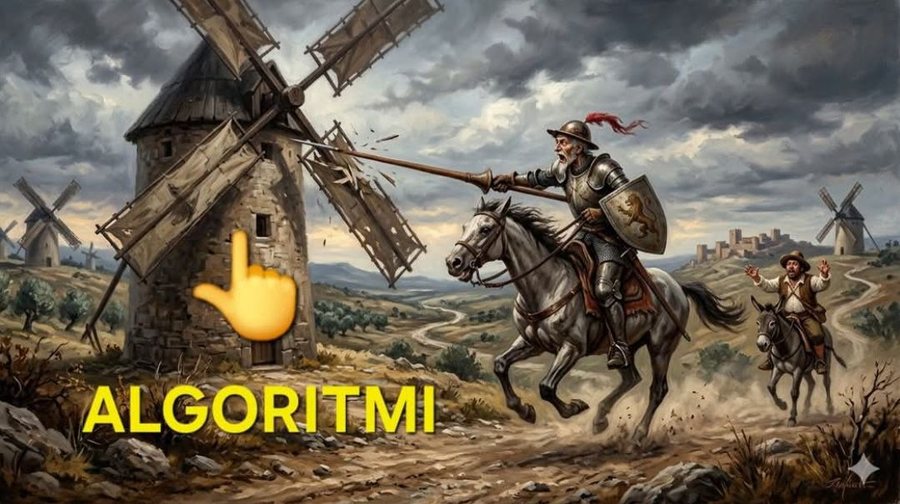
In his 20 June address to the Socialist Party, Edi Rama gave the Flamingo Revolution a single organising explanation: a “digital cyclone” in which algorithms reward outrage, perception overtakes fact, and a market of clicks manufactures political revolt.
The claim is more sophisticated than the government’s usual vocabulary of disinformation and foreign hands, and it does real political work. It moves the cause of the largest civic mobilisation in Albania in years away from how the country has been governed and onto how anger circulates online.
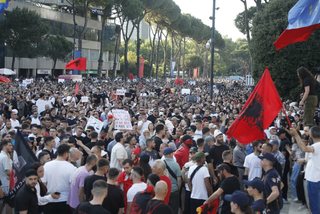
Rama described twenty days inside this “digital cyclone” set off by the protests over Zvërnec. In his account, a local confrontation between private security and a protester became a global online battle because the project was tied to Jared Kushner and, through him, to Donald Trump.
The flamingo became a symbol onto which foreign media attention, anti-Trump sentiment, domestic opposition, online fury and hostile influence could be loaded.
The first move is a displacement of causality. Rama shifts the explanation for the protest’s growth away from institutional mistrust, opaque decisions and the governance of public goods, and recasts it as the product of symbolic and algorithmic acceleration.
The political substance of the mobilisation becomes secondary to the speed, symbols and emotional charge through which it spread online.
The move matters because it changes the question a government has to answer. A protest read as a symptom of mistrust demands answers about decision-making processes, consultation, legality, accountability and the public interest.
A protest read as a digital cyclone can be managed as a problem of perception and manipulation in the digital sphere.
The sequence Rama describes is inverted. As Gjergj Erebara has argued, it was the anger that broke through the algorithm, rather than the algorithm that produced the anger.
The reaction to the events in Zvërnec crossed the platforms’ echo chambers because public anger had already reached the point of explosion. The algorithm explains how fast the message travelled. It cannot explain why it found such a large public.
From Zvërnec he builds a general theory of democracy in the digital space. Algorithms reward indignation, fear and conflict; in his account, the attention economy has become a political economy, where anger produces visibility, visibility produces influence and influence produces power.
The square, he says, has become the algorithm’s television studio, where protest is filmed to feed circulation, and the twenty-first century is producing a “proletariat of the algorithm”, a class joined by attention rather than work.
The diagnosis has substance. Platforms reward speed, spectacle and certainty, and protest now lives in the square and on the screen at once.
A video, a livestream, a meme, a police line, a wounded protester or a recognisable symbol can travel before any institution has published documents or any newsroom has established the full sequence of facts. Rama’s phrase “freedom of facts” also names a real danger: facts can be formally available and still lose public force when they are buried under distortion, threats and saturation.
The phrase becomes difficult to sustain when the government itself is one of the largest producers of pre-packaged political content and one of the main sources of the information saturation it describes.
A government that floods the public sphere with its own communication cannot easily cast itself as the guardian of facts against distortion. If facts are to survive in public, that begins with the government’s own conduct and with its obligation to transparency and accountability.
The difficulty begins where this diagnosis is turned against the legitimacy of the protest.
Once protesters are placed inside the “proletariat of the algorithm”, their agency becomes suspect: the citizen with a claim over a public good becomes a user chasing visibility, documentation becomes content, and mobilisation becomes contagion.
To call the biggest civic mobilisation in Albania in years simply a digital cyclone is to remove the obligation to distinguish its parts, and with it the obligation to answer them.
Those parts are not one thing. A false video, an opposition tactic, a citizen’s documentation, an activist’s claim, foreign media interest and a hostile information operation do not merge into a single phenomenon because they move on the same digital platforms.
Each calls for its own response: correct the false video, expose the fabricated claim, name coordinated hostile activity where evidence supports it, and treat civic documentation as core to democracy.
Folding them together is the payoff of the cyclone metaphor, because it lets every form of dissent be treated as if it were noise with no legitimacy.
The speech also draws a boundary around authority. Rama argues that democracy belongs to citizens, while insisting that every opinion cannot carry the same weight on every question.
The principle is defensible: public decisions require knowledge, evidence and responsibility. In the context of the Flamingo Revolution, however, the point has a sharper political effect. It places citizens in the role of expressing concern, while reserving the power to define valid knowledge to those already governing.
Expertise then becomes less a democratic resource than a gatekeeping language, especially when the documents, procedures and evidence behind public decisions remain incomplete, delayed or inaccessible.
Rama makes this argument from inside algorithmic politics, as one of its most accomplished practitioners.
His public style has long run on direct-to-public video, leader-centred staging, repetition, ridicule, rapid reaction and the bypassing of journalists (examples ERTV, the podcast Flasim to the “Sy m’Sy” format). It is the same architecture he now describes as a threat, but used for so many years to his own advantage.
The point goes beyond personal style. During the May 2025 campaign, a coalition of civil-society organisations found that parties supplied media with pre-packaged video and press materials, so that coverage was largely centrally produced and replayed across outlets, in an unbalanced landscape that favoured the two largest parties and offered no leader debates.
As Erebara observes, governments dominate social media through saturation: against a single critic’s post, the state can field volumes of higher-production material funded from public resources, leaving critical voices isolated. Political content is produced for platforms and recycled across portals and television in a hybrid system the government controls more than anyone.
The same readiness to control the space appeared with TikTok.
After the killing of a teenager in November 2025, the government shut the platform down for a year, and in March 2026 the Constitutional Court ruled the ban unconstitutional, holding that a blanket block was neither necessary nor proportionate and that it violated freedom of expression and the press.
A government that invokes the harms of platforms has already shown that it may move to switch them off. That is the risk: the same logic that calls the protest a cyclone can be used to narrow the space where the protest became visible.
From this speech it becomes clear that social media that carries government messaging is called democracy, leadership and direct communication. Social media that carries mobilisation against the government is called noise, hysteria and manipulation.
The speech is, plainly, a response to losing control of the narrative.
For the first time in years, the same architecture was used from below. Citizens turned video, memes, livestreams and one recognisable symbol into a mobilisation that did not wait for the television agenda to validate it, and the government could no longer set the frame. Rama contests the protest’s claims and, with them, the process that made those claims credible.
Albania does not need a prime minister to supply a new theory of democracy; it needs a prime minister who practises its basic rules.
Treating the Flamingo Revolution as a digital cyclone, as a storm to be waited out, misses its democratic force.
Shpërndaje te miqtë